WWII Comic Arts and Propaganda
Superhero Comic Books
Comic books, rising stars in popular media at the time, were heavily adapted to promote pro-American propaganda during World War II. Superheroes such as Captain America and Superman were seen battling Hitler and the Nazi forces, fighting alongside the US military, and advertising the sale of war stamps and bonds. Superheroes were characterized by their desire to do good and spread justice in the face of overwhelming evil, and because of this, comic books dramatized and even embellished the harsh realities of war. Americans were hungry for this type of narrative, and during such an uncertain and violent time, superheroes helped reinforce the vision that the American public had of themselves and their country.
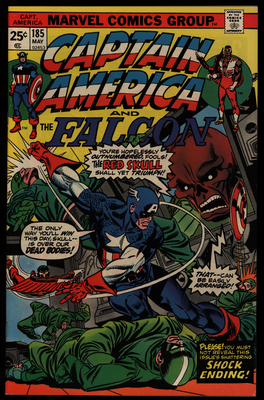
Captain America
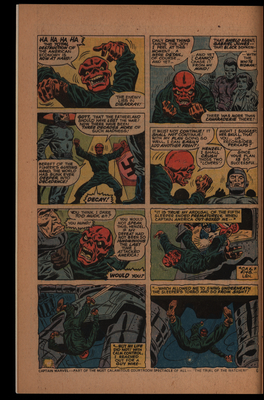
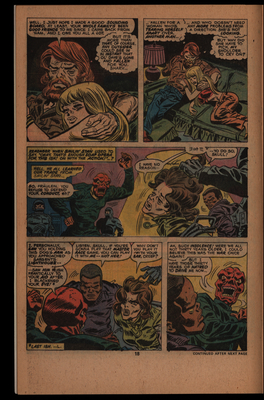
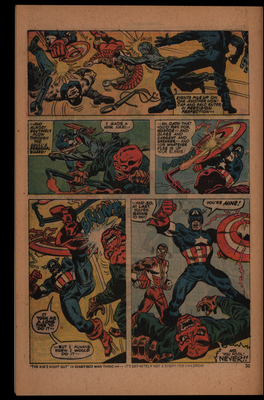
This narrative carried on even after the war had ended, and many comic books continued to publish pro-US and anti-facist messaging. These comics featured American superheroes fighting for liberty against a renowned personification of evil: The Nazi party. In Captain America and the Falcon, Vol.1, No.185 (1975), Marvel superhero Captain America was still seen fighting against Nazi villains such as Red Skull, who was still adamant in his quest to spread Nazi messaging and terrorize the American people. The drawings of Red Skull are similar to many depictions of Nazis in political cartoons published during World War II. These comics still portrayed the stereotype of the “other,” often by giving a brutish and terrifying appearance to opposing Axis characters. Created by Steve Englehart for Marvel, a muscular and powerful Captain America is seen standing proudly over a defeated Red Skull, the perfect vision of the American hero overcoming a terrifying evil.
The Invaders
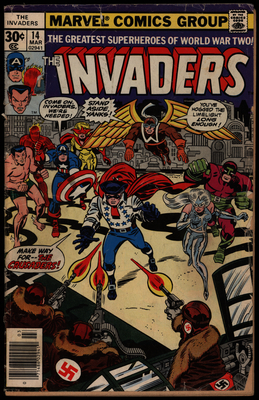
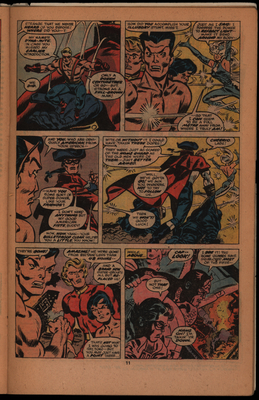
Other comics of the 1970s followed a similar format strategy, placing popular superheroes into the context of World War II. In 1975, Captain America joined forces with the Human Torch and the Sub-Mariner to fight against Nazi forces once again. The superhero team proudly pronounced themselves the Invaders, leaping into battle with the catchphrase: “Okay, Axis, here we come!”
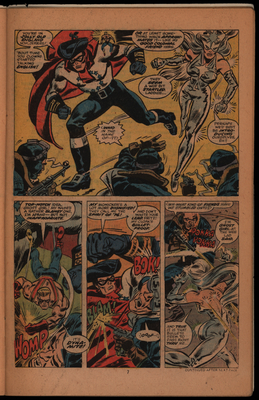
In issue no. 14 of The Invaders, the team finds themselves in the midst of a heated fight with Nazi forces over Britain, when they are assisted by six masked heroes calling themselves the Crusaders. The Crusaders are a team of British superhumans, a reference to the US’s alliance with Britain against the Axis forces. The team features a 1940s superhero proudly named the Spirit of 76, who represented a sentiment associated with the values of determination and liberty surrounding the American Revolution. “Six,” as he is called by his friends, is the only American member of the team. He sports colonial-era clothing complete with a tricorn hat, high buckled boots, and thick cuffed gloves. He dons a bulletproof cape, though claims that his only superpower is his “good American fists.” The caped Crusader is a call back to traditional values of freedom and liberty that originated at the dawn of the American Revolution, pushing the image of the US’s perseverance and strength.
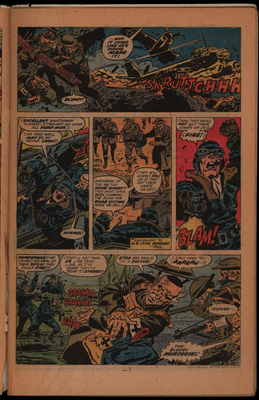
The comic also references traditional representations of Nazis in political cartoons. After the Invaders successfully ground their opponent’s plane in British territory, the wounded German soldiers are approached by British army doctors. Thinking that the men are approaching them to kill them, the German soldiers begin wildly firing their weapons, shooting anything that approaches. One of the Germans asks why they would bother to send old men after them, and another disregards this concern: “They are no match for us.” This knock to the intelligence of German soldiers frames the Nazi party as unintelligent, incompetent, trigger-happy barbarians, similar to political cartoon representations of the German people in the 1940s.
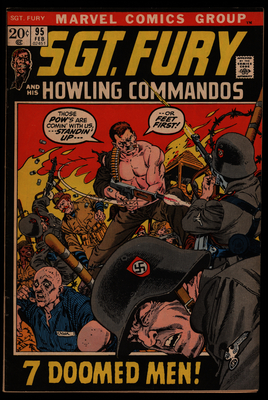
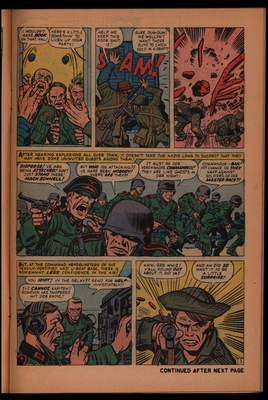
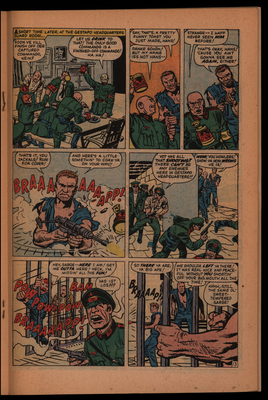
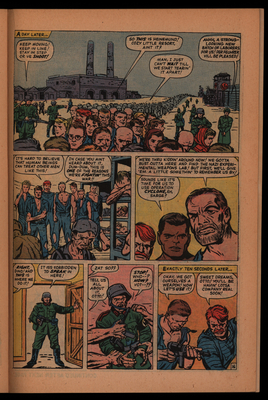
Sgt. Fury And His Howling Commandos
Other comics turned their lenses to the heroism of American troops. Sgt. Fury And His Howling Commandos features popular S.H.I.E.L.D. agent Nick Fury, serving bravely in World War II. The comic depicts Sgt. Fury and his hard-as-nails platoon fighting against the Axis forces. The crew is made up of a collection of characters, including Private Percival “Pinky” Pinkerton, an outwardly British soldier with a “bumbershoot” as his primary weapon. The addition of a British soldier to the crew pays homage to the Allied Forces of World War II. Private Gabriel Jones is another commando of note, an African American soldier and accomplished jazz musician. At the time of World War II, the US Armed Forces were not yet integrated and failed to acknowledge the contributions and accomplishments of African American soldiers. Gabriel Jones’s position as an original member of the Howling Commandos is a tribute to the unsung heroism and role of Black soldiers in World War II. However, the comic still relies on the use of stereotypes in each of these characters.
In Sgt. Fury And His Howling Commandos no. 95, published in 1971, the Commandos are captured by the enemy and forced into a Nazi work camp, which appears reminiscent of the Nazi concentration camps. The crew remark on the injustice of their imprisonment and set to quickly busting themselves out of internment. While the comic begins to broach the subject of the Holocaust, including a panel illustrating the severity of camp living conditions, the Commandos quickly turn their focus back to their original mission.