home Resources and Services Retaining Your Author Rights

Retaining Your Author Rights

Don’t Sign Away Your Rights!

Traditional publishers’ agreements often transfer copyright from the author to the publisher, giving them the right to reproduce and redistribute your work.

The most important thing you can do is read your copyright transfer agreement. Don’t like what it says? You can amend the agreements to retain the rights you need to make copies of your work and to share it with others.

Examine your publishers’ agreements

What is the publisher requiring of you? Those agreements that require you to transfer all your rights limit what you can do with your own work—that is, you are no longer the copyright holder.

If your publisher agreement reads something like: “the undersigned authors transfer ownership of copyright, including the right to publish and distribute the work by any means, method, or process whether now known or to be development in the future, to the Publisher,” consider amending the agreement.

Agreements that let you retain control of your work often have phrases like: “I grant the journal a non-exclusive license to publish my work”; “I understand that no rights are transferred to the Journal”; or “I understand that a Creative Commons license will be applied to my work.”

Modify your agreements when needed

Publishing agreements are negotiable. Know your rights and consider using the SPARC author addendum to modify your agreement.

Deposit your work in MOspace

If you’ve retained the right to post to an online archive, submit your work to the MOspace Institutional Repository. An institutional repository, like MOspace, is one of the best ways to disseminate and preserve your work.  As an open access tool, MOspace ensures that current and future generations of scholars benefit by finding your work.

More information on retaining your rights.

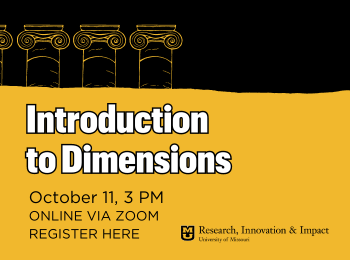
home J. Otto Lottes Health Sciences Library, Workshops Introduction to Dimensions, Oct. 11

Introduction to Dimensions, Oct. 11

Date: Friday, October 11, 2024
Time: 3:00pm – 4:00pm
Online via Zoom
Registration

The Introduction to Dimensions webinar will showcase how researchers can use this powerful database to find collaborators, track funded activity, identify trends and more.


Division of Research, Innovation & Impact

home Ellis Library, J. Otto Lottes Health Sciences Library, Resources and Services Protect Yourself and Your Research from Predatory Journal Publishers

Protect Yourself and Your Research from Predatory Journal Publishers

Predatory publishing doesn’t just take advantage of authors by misrepresenting review, editorial, and fee structures. It also hinders access to the work itself, hurting the overall enterprise of research. The epidemic of predatory journals reached serious enough heights in 2016 that the Federal Trade Commission charged OMICS, one such publisher of hundreds of predatory journals, for its deceptive practices.

“If it sounds too good to be true, it probably is,” says Janice Dysart, Science Librarian and creator of the Where to Publish Your Research guide. “Be wary of these email solicitations from publishers trying to get you to submit articles to their journals.” She recommends using the Think Check Submit checklist to determine whether a publisher is legitimate.

Anyone can fall victim to predatory journal publishers. Jung Ha-Brookshire, Associate Dean for Research and Graduate Studies, College of Human Environmental Sciences, and Associate Professor and Director of Graduate Studies, Textile and Apparel Management, relates her experience after a graduate student recommended a journal a few years ago. She says, “I didn’t think twice about it. We submitted our paper and got accepted without any revisions. Then they were asking us to send money somewhere in Pakistan.” She still didn’t realize what was happening because she hadn’t even heard of “predatory journals.”

That all changed about a year later when she learned of a list of predatory journals from her colleagues. “We found out that our journal was on that list,” she says. They tried to withdraw their work from the publication but couldn’t. Because the journal wasn’t legitimate, the article could only be found via the specific URL and not by searching, so they pulled the publication information from their CVs. Jung says, “We had to take that manuscript as a loss because we couldn’t even take that paper to other publishers since, technically, it is already published.”

After that experience, Jung now checks with her subject librarian, Noël Kopriva, every time she encounters a journal she hasn’t heard of, “no matter how good the website looks.” Jung advises, “Be careful with choosing the right journals. Do not get fooled by address, location, a beautiful website, and a wonderful set of editorial board names. Check with your librarian first when in doubt!”

For more information on how to spot predatory journal publishers, see our Where to Publish Your Research guide or contact your subject librarian

Originally published in 2018 by Jen Gravley, Research and Instruction Librarian

home Events and Exhibits, J. Otto Lottes Health Sciences Library Rare Books at the Health Sciences Library

Rare Books at the Health Sciences Library

Did you know that the Health Sciences Library has a rare book room? The Donald Silver Rare Book Room was donated to the library by the Department of Surgery in honor of Dr. Donald Silver, an emeritus professor. lt is located on the third floor of the Health Sciences Library, directly adjacent to the elevator. Viewing hours of rare books in the collection or of the room itself are available by appointment. Items can be used for research purposes and under limited conditions borrowed or scanned for use with the permission of the Rare Book Librarian or the Director of the Library, Deb Ward.

A “rare” book is considered rare because of the scarcity of item, not because of its dollar value, although at times that can be considerable. Rarity is based on a few factors: that there are few exemplars in existence, that they are primary source materials, that the intellectual content of the materials is significant, or they are old and fragile. Any one or more of those factors establishes that an item is “rare.”

The items in the Rare Book Room at HSL are placed there if they are printed before 1900 or are selected by the Director or HSL Librarians. Criteria for selection can also include considerations such as special examples of binding, fine paper, printing, or because they contain significant illustrations. Some titles are fascimilies, expertly reproduced copies, of important manuscripts and early printed books.

An item is given rare book status and retained in our library if the item affords a needed perspective on contemporary studies, or provides the opportunity to learn about early developments in the field of medicine. Other criteria include providing a historical focus on the patient, the medical environment, or medical institutions. Items, which identify a historical person or trends in medicine, or have a historical background to technological breakthroughs, are also given rare book status. We are particularly interested in collecting items relating to early medicine in Missouri.

Many of the books in our collection were donated by Clarence Martin Jackson, a former graduate of the University of Missouri. He received a B.S. in 1898, an M.S. in 1899, and an MD in 1900, all from Mizzou. He became dean of the Medical school from 1909 to 1913, and spent the rest of his career at the University of Minnesota. Jackson left over 12,000 items from his personal collection to the University of Missouri Libraries, including many of the volumes in the HSL Rare Book Room. Other books in the collection have been donated by many generous supporters over the years, or were originally purchased for the use of students and faculty in the medical and nursing programs.

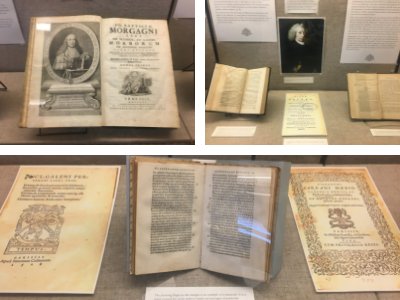
This exhibit highlights some of the important works from our collection.

The works on exhibit are:

  • Samuel Thomas von Sömmerring. Icones embryonum humanorum. Frankfurt: Varrentrapp and Wenner, 1799.
  • Giovanni Battista Morgagni. De Sedibus et Causis Morborum per Anatomen Indagatis. Venice: Ex Typographia Remondiniana, 1761.
  • John Huxham. An essay on fevers, and their various kinds, as depending on different constitutions of the blood: with dissertations on slow nervous fevers; on putrid, pestilential, spotted fevers; on the small-pox; and on pleurisies and peripneumonies. London: S. Austen, 1750.
  • Claudius Galen of Pergamon. Libri tres : Primus, De facultatum naturalium substantia. Secundus, Quod animi mores, corporis temperaturam sequuntur.  Tertius, De propiorum animi cujusque affectuum agnitione & remedio. Paris: Simon Colinaeus, 1528.
  • Florence Nightingale. Notes on nursing. New York: D. Appleton and Company, 1894.
  • Girolamo Cardano. De methodo medendi. Parisiis: Rovillii, 1565.

TAGS:

Taira Meadowcroft

Taira Meadowcroft is the Public Health and Community Engagement Librarian at the Health Sciences Library at the University of Missouri.