home Cycle of Success, J. Otto Lottes Health Sciences Library, Staff news Rebecca Graves Awarded Sinclair School of Nursing Honorary Alumni Award

Rebecca Graves Awarded Sinclair School of Nursing Honorary Alumni Award

“Rebecca Graves has been a pillar of support for the University of Missouri Sinclair School of Nursing, advancing research, education and student success,” is what attendees heard when Rebecca Graves attended the 35th Annual Nursing Banquet to accept the 2025 Honorary Alumni Award.

The Honorary Alumni award is given to someone who shows outstanding achievement in nursing or support for the nursing profession. It is through her work as an education librarian at the J. Otto Lottes Health Sciences Library that Rebecca Graves has had such a profound impact on nursing students in the beginnings of their nursing journey to the collaborative efforts with nursing faculty on key initiatives, including systematic reviews and grant-funded projects such as best practices for managing COVID-19 in nursing homes.

“We are excited to honor Rebecca for her amazing support of our faculty and students,” said Donna Otto MSN,  who was one of the nominators. “When I coordinated the RN to BSN option for the school back a few years ago, Rebecca was always so gracious to come and work with the students. This is how I knew of her value to our students and faculty.”

Faculty often count on Rebecca to lay the foundation necessary for students to understand and implement evidence-based practice strategies, a skill students will need to excel in their nursing careers, whether in clinical practice or as a nurse researcher. Her ability to simplify complex academic processes has empowered countless students, particularly those returning to academia for advanced degrees. Her approachable teaching style empowers students and strengthens the academic foundation of the Sinclair School of Nursing.

Learning goes both ways. Rebecca shared that it is such a joy to be a part of the “ah ha” moments and values how time spent with students and faculty gives her the opportunity to also learn about ever evolving health sciences.  “I deeply respect our nursing faculty for the work they do both teaching our students as well as the research they conduct to improve the health of Missourians and people in general.  Being able to assist them in this work and be a part of their team is an honor,” says Rebecca Graves.

Congratulations to Rebecca Graves for being awarded the Sinclair School of Nursing 2025 Honorary Alumni Award!

TAGS:

Taira Meadowcroft

Taira Meadowcroft is the Public Health and Community Engagement Librarian at the Health Sciences Library at the University of Missouri.

home J. Otto Lottes Health Sciences Library, Resources and Services New Ebook Highlight: Medical student well-being : an essential guide

New Ebook Highlight: Medical student well-being : an essential guide

We’ve recently added Medical student well-being : an essential guide to our online collection.

This book tackles the most common challenges that medical students experience that lead to burnout in medical school by carefully presenting guidelines for assessment, management, clinical pearls, and resources for further references. Written by national leaders in medical student wellness from around the country, this book presents the first model of care for combating one of the most serious problems in medicine.

This book addresses many topics, including general mental health challenges, addiction, mindfulness, exercise, relationships and many more of the important components that go into the making of a doctor.

You can access this book online.

home J. Otto Lottes Health Sciences Library, Resources and Services New MU Authored Trending Article in PubMed

New MU Authored Trending Article in PubMed

A recently trending article in PubMed was The impact of gut microbial short-chain fatty acids on colorectal cancer development and prevention co-authored by Boobalan Thulasinathan, Kanve Suvilesh, Sumanas Maram, Erik Grossmann, Yezaz Ghouri, Emma Teixerio, Joshua Chan, Jussuf Kaif, and Satyanarayana Rachagani.

What is a PubMed trending article?

Trending articles is a marker of increased interest in a PubMed abstract. Trending articles are those with a significant increase in daily PubMed views in the past two days as compared to the previous baseline period, which is approximately a week.

You can see the full list of trending articles here.

Interested in tracking the impact of your articles after they are published? Email asklibrary@health.missouri.edu to learn how we can help.

TAGS:

Taira Meadowcroft

Taira Meadowcroft is the Public Health and Community Engagement Librarian at the Health Sciences Library at the University of Missouri.

home J. Otto Lottes Health Sciences Library, Resources and Services New MU Authored Trending Article in PubMed

New MU Authored Trending Article in PubMed

A recently trending article in PubMed was Detection of antibodies against influenza A viruses in cattle co-authored by Yuekan Yang, Lei Shi, Sawrab Roy, Dipali Gupta, Chao Dai, Muhamma Afnan Khalid, Xiu- Feng Wan, and Wenjun Ma from the Department of Molecular Microbiology & Immunology at the School of Medicine.

What is a PubMed trending article?

Trending articles is a marker of increased interest in a PubMed abstract. Trending articles are those with a significant increase in daily PubMed views in the past two days as compared to the previous baseline period, which is approximately a week.

You can see the full list of trending articles here.

Interested in tracking the impact of your articles after they are published? Email asklibrary@health.missouri.edu to learn how we can help.

TAGS:

Taira Meadowcroft

Taira Meadowcroft is the Public Health and Community Engagement Librarian at the Health Sciences Library at the University of Missouri.

home J. Otto Lottes Health Sciences Library, Resources and Services New Books at the Health Sciences Library

New Books at the Health Sciences Library

Below are a few of the books we’ve recently added to our online collection. Find the list of this month’s new books here.

Have a purchase recommendation? You can request a book for your teaching or research using this form.

AMA guides to the evaluation of permanent impairment / medical editor, Robert D. Rondinelli 6th edition

The AMA guide is a widely recognized, standardized system for evaluating and reporting medical impairments, used by physicians and healthcare professionals to determine the extent of permanent impairment in various body systems


A video atlas of neuromuscular disorders / edited by Aziz Shaibani.

This online title is the first real cases video atlas of neuromuscular disorders. It contains close to 300 video cases taken directly from a real neuromuscular clinic, illustrating a myriad of disorders and shedding light on their diagnosis and treatment, as well as providing updates about many of them. Some rare diseases are also described, giving an opportunity for future diagnosis of these conditions in patients, despite the rarity of the condition and its infrequent presentation in clinic.

TAGS:

Taira Meadowcroft

Taira Meadowcroft is the Public Health and Community Engagement Librarian at the Health Sciences Library at the University of Missouri.

home J. Otto Lottes Health Sciences Library, Resources and Services Data Analysis Tools Available at Mizzou

Data Analysis Tools Available at Mizzou

There are a few data analysis tools available to you at the university. As well as courses to learn how to use those tools.

R: A statistical programming language that is useful for data cleaning, visualization, and other purposes related to statistical computing and data analysis.  

Python: A programming language that is commonly used for creating data visualizations, data analysis, and performing statistical calculations. 

SQL (Structured Query Language): A programming language used for storing, processing, and retrieving data in relational databases. 

REDcap: A secure application for data collection and survey management.  

TAGS:

Taira Meadowcroft

Taira Meadowcroft is the Public Health and Community Engagement Librarian at the Health Sciences Library at the University of Missouri.

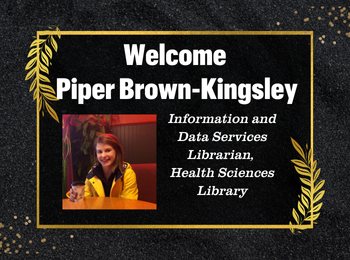
Welcome to Piper Brown-Kingsley

The MU Libraries are pleased to announce the hire of Piper Brown-Kingsley as the Information and Data Services Librarian at the Health Sciences Library. She began over the summer. Piper is a May 2024 graduate of the University of Wisconsin-Madison Information School. In addition, she’s been working as a remote Data Curation Intern at the National Neighborhood Data Archive (NaNDA) at the University of Michigan. We’re so excited to have her join the Information Services Team at the newly renovated Health Sciences Library.

home Ellis Library, J. Otto Lottes Health Sciences Library, Resources and Services Protect Yourself and Your Research from Predatory Journal Publishers

Protect Yourself and Your Research from Predatory Journal Publishers

Predatory publishing doesn’t just take advantage of authors by misrepresenting review, editorial, and fee structures. It also hinders access to the work itself, hurting the overall enterprise of research. The epidemic of predatory journals reached serious enough heights in 2016 that the Federal Trade Commission charged OMICS, one such publisher of hundreds of predatory journals, for its deceptive practices.

“If it sounds too good to be true, it probably is,” says Janice Dysart, Science Librarian and creator of the Where to Publish Your Research guide. “Be wary of these email solicitations from publishers trying to get you to submit articles to their journals.” She recommends using the Think Check Submit checklist to determine whether a publisher is legitimate.

Anyone can fall victim to predatory journal publishers. Jung Ha-Brookshire, Associate Dean for Research and Graduate Studies, College of Human Environmental Sciences, and Associate Professor and Director of Graduate Studies, Textile and Apparel Management, relates her experience after a graduate student recommended a journal a few years ago. She says, “I didn’t think twice about it. We submitted our paper and got accepted without any revisions. Then they were asking us to send money somewhere in Pakistan.” She still didn’t realize what was happening because she hadn’t even heard of “predatory journals.”

That all changed about a year later when she learned of a list of predatory journals from her colleagues. “We found out that our journal was on that list,” she says. They tried to withdraw their work from the publication but couldn’t. Because the journal wasn’t legitimate, the article could only be found via the specific URL and not by searching, so they pulled the publication information from their CVs. Jung says, “We had to take that manuscript as a loss because we couldn’t even take that paper to other publishers since, technically, it is already published.”

After that experience, Jung now checks with her subject librarian, Noël Kopriva, every time she encounters a journal she hasn’t heard of, “no matter how good the website looks.” Jung advises, “Be careful with choosing the right journals. Do not get fooled by address, location, a beautiful website, and a wonderful set of editorial board names. Check with your librarian first when in doubt!”

For more information on how to spot predatory journal publishers, see our Where to Publish Your Research guide or contact your subject librarian

Originally published in 2018 by Jen Gravley, Research and Instruction Librarian

home Events and Exhibits, J. Otto Lottes Health Sciences Library Rare Books at the Health Sciences Library

Rare Books at the Health Sciences Library

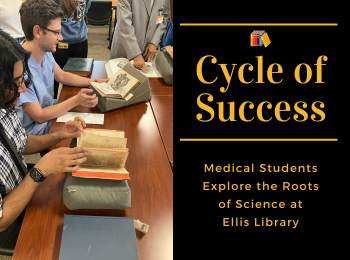
Did you know that the Health Sciences Library has a rare book room? The Donald Silver Rare Book Room was donated to the library by the Department of Surgery in honor of Dr. Donald Silver, an emeritus professor. lt is located on the third floor of the Health Sciences Library, directly adjacent to the elevator. Viewing hours of rare books in the collection or of the room itself are available by appointment. Items can be used for research purposes and under limited conditions borrowed or scanned for use with the permission of the Rare Book Librarian or the Director of the Library, Deb Ward.

A “rare” book is considered rare because of the scarcity of item, not because of its dollar value, although at times that can be considerable. Rarity is based on a few factors: that there are few exemplars in existence, that they are primary source materials, that the intellectual content of the materials is significant, or they are old and fragile. Any one or more of those factors establishes that an item is “rare.”

The items in the Rare Book Room at HSL are placed there if they are printed before 1900 or are selected by the Director or HSL Librarians. Criteria for selection can also include considerations such as special examples of binding, fine paper, printing, or because they contain significant illustrations. Some titles are fascimilies, expertly reproduced copies, of important manuscripts and early printed books.

An item is given rare book status and retained in our library if the item affords a needed perspective on contemporary studies, or provides the opportunity to learn about early developments in the field of medicine. Other criteria include providing a historical focus on the patient, the medical environment, or medical institutions. Items, which identify a historical person or trends in medicine, or have a historical background to technological breakthroughs, are also given rare book status. We are particularly interested in collecting items relating to early medicine in Missouri.

Many of the books in our collection were donated by Clarence Martin Jackson, a former graduate of the University of Missouri. He received a B.S. in 1898, an M.S. in 1899, and an MD in 1900, all from Mizzou. He became dean of the Medical school from 1909 to 1913, and spent the rest of his career at the University of Minnesota. Jackson left over 12,000 items from his personal collection to the University of Missouri Libraries, including many of the volumes in the HSL Rare Book Room. Other books in the collection have been donated by many generous supporters over the years, or were originally purchased for the use of students and faculty in the medical and nursing programs.

This exhibit highlights some of the important works from our collection.

The works on exhibit are:

  • Samuel Thomas von Sömmerring. Icones embryonum humanorum. Frankfurt: Varrentrapp and Wenner, 1799.
  • Giovanni Battista Morgagni. De Sedibus et Causis Morborum per Anatomen Indagatis. Venice: Ex Typographia Remondiniana, 1761.
  • John Huxham. An essay on fevers, and their various kinds, as depending on different constitutions of the blood: with dissertations on slow nervous fevers; on putrid, pestilential, spotted fevers; on the small-pox; and on pleurisies and peripneumonies. London: S. Austen, 1750.
  • Claudius Galen of Pergamon. Libri tres : Primus, De facultatum naturalium substantia. Secundus, Quod animi mores, corporis temperaturam sequuntur.  Tertius, De propiorum animi cujusque affectuum agnitione & remedio. Paris: Simon Colinaeus, 1528.
  • Florence Nightingale. Notes on nursing. New York: D. Appleton and Company, 1894.
  • Girolamo Cardano. De methodo medendi. Parisiis: Rovillii, 1565.
TAGS:

Taira Meadowcroft

Taira Meadowcroft is the Public Health and Community Engagement Librarian at the Health Sciences Library at the University of Missouri.