home Cycle of Success MU Libraries Integral to Research on Kafka

MU Libraries Integral to Research on Kafka

Assisted by the MU Libraries, humanities researcher Carsten Strathausen is constructing a comprehensive visual database encompassing all adaptations of Franz Kafka’s “The Trial.” This resource aims to serve scholars and students for years to come.

Research Librarian Anne Barker consulted with Carsten on the project by identifying and acquiring materials, suggesting strategies for gathering data, and pointing him to other library staff who could assist. Seth Huber, head of cataloging acquisitions and collection development,
searched for and downloaded the catalog records of versions and translations of “The Trial.”
In addition, Steven Pryor, director of digital initiatives, developed a Python web-crawler to gather metadata on these resources and played a key role in organizing the dataset. He also helped to created an Excel sheet containing vital information to track advancements, which will be useful to continue these research endeavors.

The Interlibrary Loan team played a crucial role in acquiring numerous adaptations of “The Trial” from around the globe, including artworks, films, graphic novels and more. Ivy Hui, head of the ILL Borrowing/Requesting Unit, and her dedicated team maintained regular communication with Dr. Strathausen, updating him on their progress in locating these elusive adaptations of Kafka’s text.

Dr. Stathausen is continuing his work with a grant from the MU Center for the Humanities and is organizing an international symposium on “Digital Kafka” that will take place this fall at Georgetown University.

For more information on this project and an interview with Dr. Strathausen, visit Research, Innovation and Impact.

home Cycle of Success Using Government Research to Uncover the History of the Bicycle

Using Government Research to Uncover the History of the Bicycle

Every year since 1990, bicycle enthusiasts have converged from around the world for the International Cycle History Conference (ICHC), where papers are presented on all aspects of cycle history and culture.

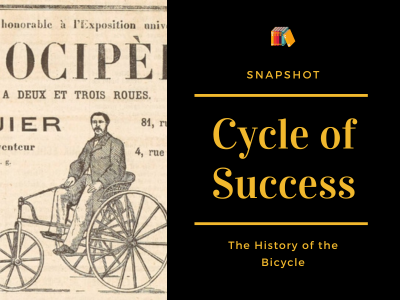
Few controversies are more important to this group than that surrounding the invention of the “boneshaker,” that is, the original bicycle of the mid-19th century powered by cranks and rotary pedals attached to the front hub. Though it appears to have originated in Paris around 1863, exactly who was responsible for that breakthrough and the original Michaux bicycle company remains unclear.

Fortunately, new technologies in library research may help solve the mystery. In 2022, MU Government Information Librarian Marie Concannon presented a paper at the ICHC titled “How to use digital libraries for historical cycling research,” and spoke about advances which allow powerful full-text searching in millions of books and government records all at once.

One of the historians in attendance was David Herlihy, author of Bicycle: The History published by Yale University Press. After hearing Ms. Concannon’s presentation, he was intrigued by the possibility of using U.S. Patent & Trademark Office databases to answer a key question: in 1869, were the founders of the Michaux company trying to purchase the original bicycle patent granted by the U.S. Patent office in November, 1866 to Pierre Lallement of Paris, France? If so, that would provide strong evidence that they knew this was a valid patent. Mr. Herlihy hopes to analyze data generated by the newly retooled U.S. Patent database, together with 19th century intellectual property law, to make that case.

Ms. Concannon was able to assist with the patent database, but needed help with intellectual property law history. She asked MU Law Librarian colleagues Randy Diamond and Cindy Shearer for input, and was delighted to see all they uncovered — about a dozen articles providing exactly the sort of legal context Mr. Herlihy was seeking, including the steps a foreigner might have taken in the 1860s to either purchase or overturn an existing U.S. patent. Taking such actions could indirectly reveal that individual’s opinion of the bicycle’s rightful inventor.

For now it remains a mystery to us, while Mr. Herlihy works through all the materials sent by our team of librarians. We can’t wait to see his next ICHC paper!

home Resources and Services Changes to the Library Catalog

Changes to the Library Catalog

This summer, the University of Missouri System Libraries changed the search features that affect how to search for library materials. The contract for our previous library catalog had ended, and that vendor chose not to submit a bid to renew the contract. Consequently, we had to choose a new vendor. We know that change can be disruptive, and we appreciate your patience as we all learn how to use the new catalog, which continues to evolve. Despite the changes, the MU Libraries continue to be committed to providing our faculty and students access to the library resources needed to be successful in learning, teaching and research. We hope you’ll reach out to staff for assistance as needed.

Please visit our Changes to the Catalog page, for information on how to use the new search system.

home Cycle of Success Nine Years Old and Alone in 1889

Nine Years Old and Alone in 1889

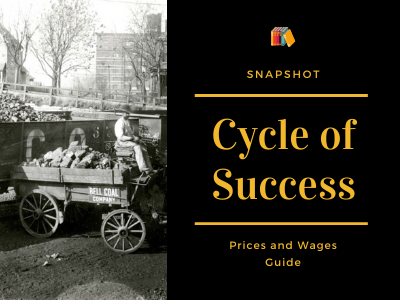
“If a child picked up coal at a Kansas City train yard in 1889, how much money might he get for one bucket”?

This intriguing question was recently submitted to the MU Libraries by Mary Hadreas of Astoria, Oregon. Only after answering the question did we find out why she was asking.

Marie Concannon, Head of Government Information, knew where to find the price of coal in Kansas in 1889. Unfortunately it was expressed in price per ton. She shared the question with Cade McKnelly, a student assistant in the Government Information office. Cade is an Economics major and is great with mathematical questions. He found the volume of a ton of coal and performed the calculations, arriving at an answer: the child might receive one cent for each bucket of coal gathered.

Mary Hadreas

When we sent this result back to Ms. Hadreas, she amazed us by saying that our response confirmed a family legend. According to the stories passed down through an elderly aunt, Shad Houston Whittaker (1880-1964) had left home to make his way in the world at age nine. The statement from his parents was “You are a big boy and it is time to take care of yourself,” and he did. He found his way to Kansas City by following the railroad track. Once there, he earned some money by gathering coal for a penny per bucket. Ms. Hadreas wanted to fact-check this remarkable story before committing it to her family history book. She found us through the “Prices and Wages by Decade” guide on the MU Libraries website.

As for Shad, despite starting out with so little, his was a story of resilience. From gathering coal, he worked his way up in a succession of railroad jobs, ultimately became an engineer!

We want to thank Ms. Hadreas for allowing us to share this inspiring story.

Cycle of Success is the idea that libraries, faculty, and students are linked; for one to truly succeed, we must all succeed. The path to success is formed by the connections between University of Missouri Libraries and faculty members, between faculty members and students, and between students and the libraries that serve them. More than just success, this is also a connection of mutual respect, support, and commitment to forward-thinking research.

If you would like to submit your own success story about how the libraries have helped your research and/or work, please use the Cycle of Success form.

Image of coal wagon: Historic Kansas City Foundation Collection (SC224)

home Cycle of Success, Ellis Library Rare Materials Essential to Understanding History

Rare Materials Essential to Understanding History

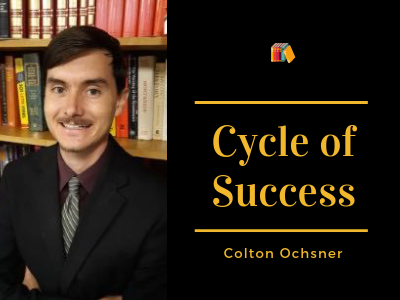
Colton Ochsner, a history doctoral student at MU, does research on the origins of fantasy and science fiction films in modern German history. Colton chose the German cinema as his concentration because German films have become very influential. “They made a lot of movies that have spread across the world and influenced film, especially to America. Anything from Blade Runner to Star Wars has been inspired in some way by a lot of these older movies, especially visually. I have been drawn to these older movies in particular because I have known about the occult and I have seen it working in these movies and yet no scholar has pointed it out,” he said.

Knowing how specialized his research could be, Colton sought the help of Ellis librarians. “My research wouldn’t be possible without the librarians help because the books and movies from this era require Interlibrary Loan (ILL) to access them,” Colton said.

“The research Colton is doing on film and esoteric groups in Germany in the 1920s requires materials that are pretty sparse and many have not survived World War II and post-war disruptions,” said Anne Barker, humanities librarian. Anne is also fluent in German and how German libraries are structured, which makes it easier to fulfill Colton’s research requests. Anne helped Colton with deciphering references as he was trying to locate books and articles often with incomplete information. Anne said, “We’re so used to finding things online, it’s easy to forget that many things have not yet been digitized or indexed well.”

Since 2013, the ILL department processed more than 1,200 ILL requests for Colton. Oi-Chi (Ivy) Hui, head of ILL borrowing, works with Colton to fulfill the obscure requests. “It’s teamwork,” Ivy said. She has requested materials for Colton from Germany, France, Switzerland, Canada and throughout the United States. “Since these requests were not processed through the system, tracking correspondence manually and signing papers for copyright compliance is a challenge. Some of these materials took months before they got here,” Ivy said.

“The basic related teachings of the occult during this time-period that includes writings and images are important because in Germany people associated images, ideas and emotions with films,” Colton said. The research materials gave Colton the confirmation he needed. During his research, Colton found a poster from a 1919 film. While looking at the poster, he discovered the name of a book he had never heard. It turns out only two libraries in the world had the book. “It was a piece of pulp fiction literature from 1919. It was only published because it was going to be used to make an action and adventure movie,” he stated. Ivy was able to find the obscure book with the minimal information available and successfully filled the request.

With Anne and Ivy’s help, Colton continues to work on his research with a projected graduation date of 2023.

Cycle of Success is the idea that libraries, faculty, and students are linked; for one to truly succeed, we must all succeed. The path to success is formed by the connections between University of Missouri Libraries and faculty members, between faculty members and students, and between students and the libraries that serve them. More than just success, this is also a connection of mutual respect, support, and commitment to forward-thinking research.

If you would like to submit your own success story about how the libraries have helped your research and/or work, please use the Cycle of Success form.

Article written by Christina Mascarenas