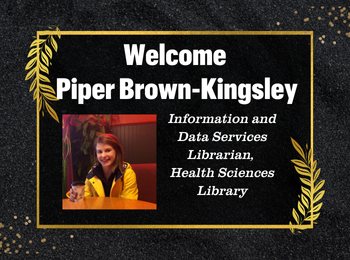
Welcome to Piper Brown-Kingsley

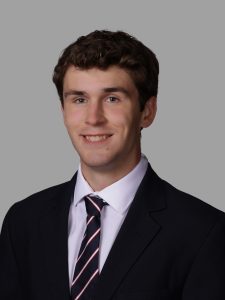
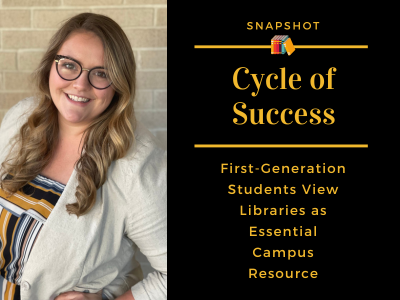
The MU Libraries are pleased to announce the hire of Piper Brown-Kingsley as the Information and Data Services Librarian at the Health Sciences Library. She began over the summer. Piper is a May 2024 graduate of the University of Wisconsin-Madison Information School. In addition, she’s been working as a remote Data Curation Intern at the National Neighborhood Data Archive (NaNDA) at the University of Michigan. We’re so excited to have her join the Information Services Team at the newly renovated Health Sciences Library.

home Cycle of Success Congratulations to Paula Roper, Winner of MLA Outstanding Professional Librarian

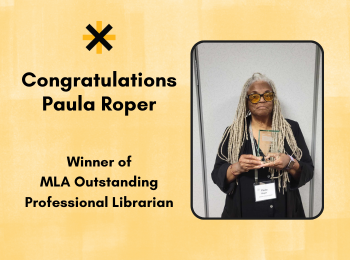
Congratulations to Paula Roper, Winner of MLA Outstanding Professional Librarian

Dr. Paula Roper was named Outstanding Professional Librarian at the 2024 Missouri Library Association Conference in Kansas City, Missouri. First awarded in 2017, the Outstanding Professional Librarian Award recognizes a librarian with an MLS or MLIS degree who has made a significant contribution to the improvement and advancement of library and information services. Nominees must have at least five years post- MLS/MLIS work in the library profession.

Dr. Paula Roper has worked for University of Missouri Libraries for nearly 40 years, beginning her career at Ellis Library as part of the inaugural MU postgraduate “Intern-Scholar Program” in 1986. During her time at Ellis, Dr. Roper has worked closely with the MU School of Education and the Black Studies Department to aid both students and faculty, from the early days of online catalogs to the current challenges of navigating AI software. She has also advocated for the Library’s involvement across campus, including large, public events like Black History Month programming and National History Day. Her experience, knowledge, and drive is valued by both her library colleagues and the faculty at her liaison departments. As one of her colleagues puts it, Dr. Roper “encourag[es] and valu[es] her less experienced colleagues, spurring us to get out of our academic comfort zone, and embrace the power we have, as architects of ‘extracurricular curriculum’.”

home Cycle of Success MU Libraries Integral to Research on Kafka

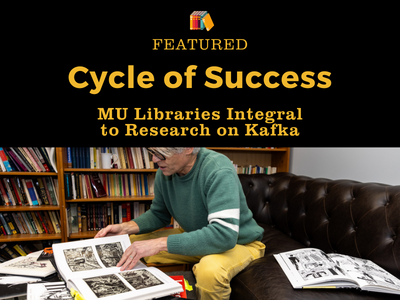
MU Libraries Integral to Research on Kafka

Assisted by the MU Libraries, humanities researcher Carsten Strathausen is constructing a comprehensive visual database encompassing all adaptations of Franz Kafka’s “The Trial.” This resource aims to serve scholars and students for years to come.

Research Librarian Anne Barker consulted with Carsten on the project by identifying and acquiring materials, suggesting strategies for gathering data, and pointing him to other library staff who could assist. Seth Huber, head of cataloging acquisitions and collection development,
searched for and downloaded the catalog records of versions and translations of “The Trial.”
In addition, Steven Pryor, director of digital initiatives, developed a Python web-crawler to gather metadata on these resources and played a key role in organizing the dataset. He also helped to created an Excel sheet containing vital information to track advancements, which will be useful to continue these research endeavors.

The Interlibrary Loan team played a crucial role in acquiring numerous adaptations of “The Trial” from around the globe, including artworks, films, graphic novels and more. Ivy Hui, head of the ILL Borrowing/Requesting Unit, and her dedicated team maintained regular communication with Dr. Strathausen, updating him on their progress in locating these elusive adaptations of Kafka’s text.

Dr. Stathausen is continuing his work with a grant from the MU Center for the Humanities and is organizing an international symposium on “Digital Kafka” that will take place this fall at Georgetown University.

For more information on this project and an interview with Dr. Strathausen, visit Research, Innovation and Impact.

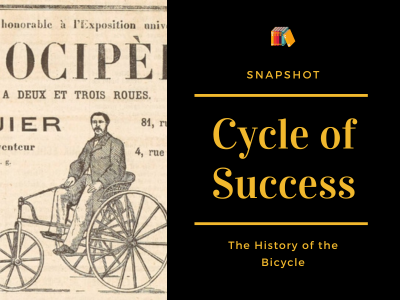
home Cycle of Success Using Government Research to Uncover the History of the Bicycle

Using Government Research to Uncover the History of the Bicycle

Every year since 1990, bicycle enthusiasts have converged from around the world for the International Cycle History Conference (ICHC), where papers are presented on all aspects of cycle history and culture.

Few controversies are more important to this group than that surrounding the invention of the “boneshaker,” that is, the original bicycle of the mid-19th century powered by cranks and rotary pedals attached to the front hub. Though it appears to have originated in Paris around 1863, exactly who was responsible for that breakthrough and the original Michaux bicycle company remains unclear.

Fortunately, new technologies in library research may help solve the mystery. In 2022, MU Government Information Librarian Marie Concannon presented a paper at the ICHC titled “How to use digital libraries for historical cycling research,” and spoke about advances which allow powerful full-text searching in millions of books and government records all at once.

One of the historians in attendance was David Herlihy, author of Bicycle: The History published by Yale University Press. After hearing Ms. Concannon’s presentation, he was intrigued by the possibility of using U.S. Patent & Trademark Office databases to answer a key question: in 1869, were the founders of the Michaux company trying to purchase the original bicycle patent granted by the U.S. Patent office in November, 1866 to Pierre Lallement of Paris, France? If so, that would provide strong evidence that they knew this was a valid patent. Mr. Herlihy hopes to analyze data generated by the newly retooled U.S. Patent database, together with 19th century intellectual property law, to make that case.

Ms. Concannon was able to assist with the patent database, but needed help with intellectual property law history. She asked MU Law Librarian colleagues Randy Diamond and Cindy Shearer for input, and was delighted to see all they uncovered — about a dozen articles providing exactly the sort of legal context Mr. Herlihy was seeking, including the steps a foreigner might have taken in the 1860s to either purchase or overturn an existing U.S. patent. Taking such actions could indirectly reveal that individual’s opinion of the bicycle’s rightful inventor.

For now it remains a mystery to us, while Mr. Herlihy works through all the materials sent by our team of librarians. We can’t wait to see his next ICHC paper!

home Cycle of Success Nine Years Old and Alone in 1889

Nine Years Old and Alone in 1889

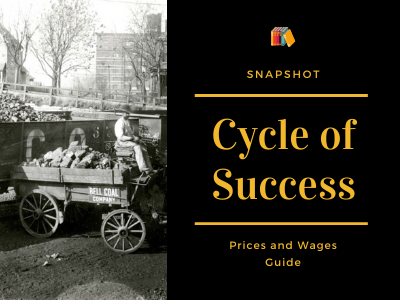
“If a child picked up coal at a Kansas City train yard in 1889, how much money might he get for one bucket”?

This intriguing question was recently submitted to the MU Libraries by Mary Hadreas of Astoria, Oregon. Only after answering the question did we find out why she was asking.

Marie Concannon, Head of Government Information, knew where to find the price of coal in Kansas in 1889. Unfortunately it was expressed in price per ton. She shared the question with Cade McKnelly, a student assistant in the Government Information office. Cade is an Economics major and is great with mathematical questions. He found the volume of a ton of coal and performed the calculations, arriving at an answer: the child might receive one cent for each bucket of coal gathered.

Mary Hadreas

When we sent this result back to Ms. Hadreas, she amazed us by saying that our response confirmed a family legend. According to the stories passed down through an elderly aunt, Shad Houston Whittaker (1880-1964) had left home to make his way in the world at age nine. The statement from his parents was “You are a big boy and it is time to take care of yourself,” and he did. He found his way to Kansas City by following the railroad track. Once there, he earned some money by gathering coal for a penny per bucket. Ms. Hadreas wanted to fact-check this remarkable story before committing it to her family history book. She found us through the “Prices and Wages by Decade” guide on the MU Libraries website.

As for Shad, despite starting out with so little, his was a story of resilience. From gathering coal, he worked his way up in a succession of railroad jobs, ultimately became an engineer!

We want to thank Ms. Hadreas for allowing us to share this inspiring story.

Cycle of Success is the idea that libraries, faculty, and students are linked; for one to truly succeed, we must all succeed. The path to success is formed by the connections between University of Missouri Libraries and faculty members, between faculty members and students, and between students and the libraries that serve them. More than just success, this is also a connection of mutual respect, support, and commitment to forward-thinking research.

If you would like to submit your own success story about how the libraries have helped your research and/or work, please use the Cycle of Success form.

Image of coal wagon: Historic Kansas City Foundation Collection (SC224)

home Cycle of Success, Ellis Library Rare Materials Essential to Understanding History

Rare Materials Essential to Understanding History

Colton Ochsner, a history doctoral student at MU, does research on the origins of fantasy and science fiction films in modern German history. Colton chose the German cinema as his concentration because German films have become very influential. “They made a lot of movies that have spread across the world and influenced film, especially to America. Anything from Blade Runner to Star Wars has been inspired in some way by a lot of these older movies, especially visually. I have been drawn to these older movies in particular because I have known about the occult and I have seen it working in these movies and yet no scholar has pointed it out,” he said.

Knowing how specialized his research could be, Colton sought the help of Ellis librarians. “My research wouldn’t be possible without the librarians help because the books and movies from this era require Interlibrary Loan (ILL) to access them,” Colton said.

“The research Colton is doing on film and esoteric groups in Germany in the 1920s requires materials that are pretty sparse and many have not survived World War II and post-war disruptions,” said Anne Barker, humanities librarian. Anne is also fluent in German and how German libraries are structured, which makes it easier to fulfill Colton’s research requests. Anne helped Colton with deciphering references as he was trying to locate books and articles often with incomplete information. Anne said, “We’re so used to finding things online, it’s easy to forget that many things have not yet been digitized or indexed well.”

Since 2013, the ILL department processed more than 1,200 ILL requests for Colton. Oi-Chi (Ivy) Hui, head of ILL borrowing, works with Colton to fulfill the obscure requests. “It’s teamwork,” Ivy said. She has requested materials for Colton from Germany, France, Switzerland, Canada and throughout the United States. “Since these requests were not processed through the system, tracking correspondence manually and signing papers for copyright compliance is a challenge. Some of these materials took months before they got here,” Ivy said.

“The basic related teachings of the occult during this time-period that includes writings and images are important because in Germany people associated images, ideas and emotions with films,” Colton said. The research materials gave Colton the confirmation he needed. During his research, Colton found a poster from a 1919 film. While looking at the poster, he discovered the name of a book he had never heard. It turns out only two libraries in the world had the book. “It was a piece of pulp fiction literature from 1919. It was only published because it was going to be used to make an action and adventure movie,” he stated. Ivy was able to find the obscure book with the minimal information available and successfully filled the request.

With Anne and Ivy’s help, Colton continues to work on his research with a projected graduation date of 2023.

Cycle of Success is the idea that libraries, faculty, and students are linked; for one to truly succeed, we must all succeed. The path to success is formed by the connections between University of Missouri Libraries and faculty members, between faculty members and students, and between students and the libraries that serve them. More than just success, this is also a connection of mutual respect, support, and commitment to forward-thinking research.

If you would like to submit your own success story about how the libraries have helped your research and/or work, please use the Cycle of Success form.

Article written by Christina Mascarenas


home Cycle of Success, Ellis Library Institutional Support Models Could Revolutionize Open Access Publishing

Institutional Support Models Could Revolutionize Open Access Publishing

In addition to “producing grammatical descriptions and dictionaries for four varieties of the Luyia language cluster in western Kenya,” Michael Marlo is an Associate Professor of English and Linguistics and a member of the editorial board of the Language Science Press‘s Contemporary African Linguistics series. Language Science Press is an open access publisher of peer-reviewed linguistics books, including textbooks, and neither readers nor authors pay fees under the Knowledge Unlatched model, which instead relies on financial pledges from institutions and libraries to fund open access projects.

Michael’s editorship originally grew out of a desire to find a financially reasonable publishing outlet for the proceedings of the Annual Conference on African Linguistics. When researching potential publishers for book projects related to his National Science Foundation project, Structure and Tone in Luyia, he had also made note of their African Language Grammars and Dictionaries series.

“One of the major obstacles to the development of the field of linguistics is access to research results,” Michael says. For example, access to the digital version of the most prestigious publisher’s grammar series costs $10,000 plus annual fees for updates. A single book costs $200. Despite the prestige, Michael doesn’t intend to pursue publication through a press with such a prohibitive pricing model because that would limit his audience to those few whose libraries can afford access. He says, “While I recognize that there are still problems of access with publications that are primarily available as PDF downloads online, due to the fact that not everyone has internet access, having my work available for anyone to download is a major improvement in access over most other publishing options, which are either too expensive for readers or require a large subvention from the author, or both.”

Anne Barker

Last summer, Michael learned that Language Science Press was pursuing the institutional support funding model and asked Anne Barker, his subject librarian, if Mizzou Libraries could contribute. He was “thrilled” to learn that some funds from the National Endowment for the Humanities were able to be put toward the initiative. Michael says, “I believe [this model] has the chance to revolutionize publishing in my field, and possibly by extension many other fields in academia.”

Anne confirms, “Librarians have long been concerned that the commercialization of scholarly communication restricts access for individuals and strains library budgets. Changing the traditional publication funding model to provide for more open access is complex and challenging, but the Knowledge Unlatched model is promising. Mizzou Libraries is glad to be able to join this endeavor.”

Michael encourages students to use MOBIUS and Interlibrary Loan to access books outside of our collection. He also encourages students to find their subject areas in the stacks and look around. “There’s a lot of great stuff in there that you won’t easily find just by searching online databases!”

Cycle of Success is the idea that libraries, faculty, and students are linked; for one to truly succeed, we must all succeed. The path to success is formed by the connections between University of Missouri Libraries and faculty members, between faculty members and students, and between students and the libraries that serve them. More than just success, this is also a connection of mutual respect, support, and commitment to forward-thinking research.

If you would like to submit your own success story about how the libraries have helped your research and/or work, please use the Cycle of Success form.

home Cycle of Success, Ellis Library, Government Information Knowledge of Sailors’ Wages Enhances Tours of Only Above-Water Whaleback Ship Museum

Knowledge of Sailors’ Wages Enhances Tours of Only Above-Water Whaleback Ship Museum

This guest post is written by Martin Karpa, Volunteer with the Superior Public Museums in Superior, Wisconsin.

My first job after graduating high school was on a ship sailing the Great Lakes. I worked the freighters for four seasons, hauling iron ore, coal, grain, sand and limestone from Duluth, MN, to Buffalo, NY, and numerous ports in between.

It was just within the last two years that projects around the home were winding down, freeing up more time for interests. With a sailing history and fondness of said, I took an interest in the Superior Public Museums, Superior, WI, of which one of the museums is the last-in-the-world above-water whaleback steamship S.S. Meteor. Volunteer efforts with the museums started out with their annual Volunteer Work Weekend held every last weekend in April when people come from across the Upper Midwest to preserve and prepare the Meteor for guests who tour the ship and learn about its history, sailing in the 1890s, the conception of its unique design and the influence this design has had on the present day shipping industry.

The first work weekend on the Meteor only piqued my interests and I wound up volunteering to come every couple of weeks or so to help out with routine seasonal maintenance on the ship. One thing leads to another, and this role in maintenance has now expanded to also being a volunteer tour guide not only for the Meteor but also at another of the museums, Fairlawn Mansion.

My opinion: dedicated tour guides are not given enough credit. These individuals put themselves out there before the general public and are expected to be the resident authority of what they are teaching, able to field any question thrown at them. Guides will learn the tour script, of course, but many will go above and beyond, gleaning all the facts they can about their particular expertise in order to answer even the most unpredictable question as best they can.

Marie Concannon

One such question was, “What were the sailors’ wages at the time?” (referring to sailors in the 1890s). I didn’t know, said so, and spent some time with the individual after the tour trying to find an answer on the internet without satisfying success. This lead to a more extensive internet search later at home, also without much concrete success. Now, I am not an idiot, but doing such specific research is not in my educational background. All of the clicking around on the net somehow lead me to Marie Concannon‘s contact information as the University of Missouri Libraries’ Head of Government Information. With mounting frustrations over negative search results and no better idea as to where to go with this question, I fired off an email to Marie last August, knowing it was a crapshoot . . . a roll of the dice . . . and I hit the jackpot!

Marie responded promptly, and a very pleasant correspondence followed, impressing me with her passion and dedication to her work. It was obvious even across the internet that she is enthusiastic about researching an issue and my hat is off to her. Information provided by Marie has now been adopted and fit into my personal script when giving tours of the S.S. Meteor, giving those interested in this aspect of our nation’s industrial history a better understanding of daily life at the end of the Victorian Era, beginning of the Gilded Age and into the Progressive Era. Being able to offer more detailed information to guests of the museum also gives them a fuller experience, which in turn helps spread an even more positive review of their visit.

Cycle of Success is the idea that libraries, faculty, and students are linked; for one to truly succeed, we must all succeed. The path to success is formed by the connections between University of Missouri Libraries and faculty members, between faculty members and students, and between students and the libraries that serve them. More than just success, this is also a connection of mutual respect, support, and commitment to forward-thinking research.

Although the Cycle of Success typically focuses on the relationships among the Libraries, faculty, and students, the Libraries also contribute to the success of all the communities Mizzou serves. The Libraries are an integral part of Mizzou’s mission “to produce and disseminate knowledge that will improve the quality of life in the state, the nation and the world.”

If you would like to submit your own success story about how the libraries have helped your research and/or work, please use the Cycle of Success form.

home Cycle of Success, Ellis Library Collaboration Builds Collections

Collaboration Builds Collections

The story of how Mizzou Libraries came to be one of the few libraries with a nearly complete set of Bildende Kunst, a visual arts journal from the former German Democratic Republic, began with an email but involved many hands. In Leipzig, Germany, on research leave, Assistant Professor Seth Howes contacted his subject librarian, Anne Barker, to ask about access to the journal after he returned to Mizzou. Without microfilm or online versions and with the closest complete set of the journal located in New York, Anne determined that access would be very difficult.

In the end, Seth considered not only “here’s why this is important to me” but also “here’s how important this is to me,” contributing some of his funds for research materials, matched by library funds, towards the purchase of additional issues.

Seth’s research focuses on the literature and experimental music and film of East Germany in its final fifteen years of existence, and Mizzou Libraries already had full print runs of the other two critical journals for his research, covering literature and music. Bildende Kunst can be translated as “Visual Art” or as “Educating Art or Art that Educates,” Seth explains. Because it reproduced art otherwise unavailable to East Germans, Bildende Kunst served as an educational magazine as well as a trade journal aimed at professionals.

Anne Barker

“One of the things that I think is very cool about having this in our collection now,” Seth says, “is that as a research institution with the teaching mission that comes with being a land-grant institution, we always need to think about how we can translate our work into teaching, and that is to a great extent what that journal did.” He plans on scheduling sessions with Special Collections in his courses so he can show students how these ideas were debated: “Can we have socialist art that looks like this? Is it not distracting or alienating to paint a worker in this way? Shouldn’t we just take recourse to 19th century realist painterly techniques?” Seth finds that students who are visual thinkers connect in a more meaningful way with a richly illustrated journal than ones that require greater language fluency to decode “communists arguing with each other.”

Anne says, “I was excited by this opportunity to enhance our research and teaching collections, but also because this adds to regional resources, making this important publication much more accessible to scholars in Missouri and surrounding states. I’m grateful for Seth’s initiative and willingness to invest his personal research funds to make this acquisition possible.”

Seth suggests that students and faculty think of “the library’s existing strengths as a jumping off point for our imagination of how to make strategic additions or strategic developments in new directions.” Despite budget challenges, he has found that “there is a will to grow the library’s resources for research and teaching, and everybody here is obviously working like mad to make resources available to students and faculty.”

Special Thanks

Many Mizzou Libraries staff members in addition to Anne played vital roles in getting the journal issues onto our shelves:

  • Corrie Hutchinson, Head of Acquisitions, identified and worked with the German vendor, determining costs and handling payments
  • Libby Myre, Senior Library Information Specialist, identified and worked with the German vendor, determining costs and handling payments, and input the journal’s information into the catalog
  • Michaelle Dorsey, Senior Library Information Specialist, with assistance from her preservation assistants, created containers to store the journal in its original format
  • Bette Stuart, Senior Library Information Specialist, input the journal’s information into the catalog
  • Kelli Hansen, Interim Head of Special Collections, provided space for the collection

Cycle of Success is the idea that libraries, faculty, and students are linked; for one to truly succeed, we must all succeed. The path to success is formed by the connections between University of Missouri Libraries and faculty members, between faculty members and students, and between students and the libraries that serve them. More than just success, this is also a connection of mutual respect, support, and commitment to forward-thinking research.

If you would like to submit your own success story about how the libraries have helped your research and/or work, please use the Cycle of Success form.

Save

Save

Save

Save

home Cycle of Success, Ellis Library Libraries Are Where You Go When You Run out of Ideas

Libraries Are Where You Go When You Run out of Ideas

Research Enriches Undergraduate Writers’ Creative Nonfiction

Julija Šukys, Assistant Professor of English and creative nonfiction writer, says, “Libraries are one of my great loves. I’m a huge champion of libraries.” Much of her work is deeply researched, including her most recent books. Epistolophilia: Writing the Life of Ona Šimaitė is an unconventional biography of the Lithuanian librarian whose heroic actions saved an untold number of lives during the Holocaust, while Siberian Exile: Blood, War, and a Granddaughter’s Reckoning, published in October, investigates her own family’s complicated history.

Julija introduces her advanced undergraduate students to the pleasures of combining research and creative work by incorporating a library research day into all of her nonfiction workshops. She finds that sometimes students at this level are “starting to tell the same stories over and over again,” and research is “a way of showing them how you break out of that, how you break out of writing the same narratives. It’s a way of showing them that there’s a bigger world and to look up, to look out, and to learn something as you write. Writing is a way of actually understanding the world better.”

Example Research Topics: the history and evolution of pinball, Berlin nightclub culture, narcissistic personality disorder and marriage, personality formation in fraternal versus identical twins, the hemp industry in the United States, the link between ear infections in children and the development of speech disorders, the influence of anxiety and depression on memory formation, the history of women in cycling, and American mobility and student mobility across the countryStudents begin by drafting personal essays and then are instructed to ask themselves, “What’s the piece that I could crack open with the help of research?” At this point, Julija sends Anne Barker, her subject librarian, their list of research questions. Because the topics arise out of students’ personal stories and interests, this list can be quite quirky.

By the time students show up at the library, Anne has gathered resources appropriate to the various topics. These workshops meet for weekly for two and a half hours, so one class session can accommodate both instruction and practice. During the first half of the session, Anne introduces them to library databases and also demonstrates search strategies that facilitate research “in the broadest terms.” Julija says, “We search really wide-ranging stuff, both scholarship as well as how to find things on Google Books, how to find movies, how to find video clips that are going to be interesting and useful. Students learn that there’s this enormous world that’s available to them.”

Then during the second half of the session, students begin their quest to find two sources for their essays. They have time to run searches, ask questions, and find books in the stacks. Julija reports that students often have their first experience requesting books through MOBIUS or interlibrary loan, or as she calls it, experiencing “the pleasure of having books sent to you from other places in the world.” Some of her students end up using maps or newspapers or doing genealogical research. “What I really want them to learn,” Julija says, “is how to work in a library and how to think about resources and for them to discover the pleasure of working both with archival materials and with books.”

This assignment brings what Anne calls her “detective instincts” to the forefront. She says, “I enjoy working individually with the students to think of different angles to pursue and different types of materials that could augment their research and then seeing them return with the things they’ve discovered. It’s like opening a treasure chest whose contents they can continue to explore for a long time.”

Anne Barker

In addition to helping students find new possibilities in their writing, Anne’s instruction helps Julija accomplish her mission of teaching her students how to use libraries. “Libraries are good places to work, and libraries are places for solace,” she tells them. “Libraries can be this place where you go when you’ve run out of ideas.”

Julija advises other instructors interested in incorporating library instruction into their classes to “plan it in advance and contact the subject librarian early.” She has also found that giving students concrete tasks helps them be able to put what they’ve learned to immediate use, and another recommendation is to “give students class time to do the hands-on work.” Conducting their own research with a librarian available gives students an appropriate balance of independence and support. “It’s very individualized, and on the other hand they’re learning transferable skills.”

Julija’s advice to students is simple: “Talk to a reference librarian because they have skills you can’t even imagine.”

Cycle of Success is the idea that libraries, faculty, and students are linked; for one to truly succeed, we must all succeed. The path to success is formed by the connections between University of Missouri Libraries and faculty members, between faculty members and students, and between students and the libraries that serve them. More than just success, this is also a connection of mutual respect, support, and commitment to forward-thinking research.

If you would like to submit your own success story about how the libraries have helped your research and/or work, please use the Cycle of Success form.