home Uncategorized Your Subject Librarian Can Support Your Teaching and Research

Your Subject Librarian Can Support Your Teaching and Research

The subject librarians at the Mizzou Libraries serve as academic partners for faculty, departments and research teams across campus. With expertise in specific disciplines, they help connect faculty with the collections, services and research support needed for teaching, scholarship and student success.

Faculty can work with subject librarians in several ways. Subject librarians develop collections that support current and emerging curricular and research needs, serve as liaisons between academic departments and the Libraries, and provide specialized research assistance for faculty and students.

As collection specialists, subject librarians collaborate with faculty to identify resources that support instruction, course development and scholarly inquiry, including books, journals, databases and other materials. These partnerships help ensure that library collections remain aligned with departmental priorities and evolving areas of study.

Subject librarians also serve as primary contacts for departments, sharing timely information about library resources and services while bringing faculty needs and perspectives back to the Libraries. This liaison role supports stronger communication, more responsive services and deeper collaboration between the Libraries and the academic community.

Faculty are encouraged to consult with their subject librarian on research projects, course assignments and effective use of print and online resources. Subject librarians can provide guidance on copyright, citation metrics, citation managers, data management, literature reviews, open access, open educational resources, digital repositories and more. They can also help connect students with research support for assignments and projects. Contact your subject librarian today!

home Uncategorized Non-Generative AI Features Expanding Across Library Databases

Non-Generative AI Features Expanding Across Library Databases

As artificial intelligence tools become increasingly common in research products, many database vendors are integrating AI features directly into their platforms. Several major research databases that the Mizzou Libraries subscribe to are providing new ways for users to discover and interact with information.

Researchers may notice different types of AI features depending on the database they are using:

  • Discover@MU includes AI Assisted Search (formerly Natural Language Search), which users can choose to enable.
  • JSTOR offers an AI Research Tool that users can toggle on.
  • ProQuest databases include a Research Assistant that automatically appears when a search is performed.
  • SciFinder provides CAS Newton, allowing users to choose between a traditional search and an AI-powered search experience.

These vendor-developed AI tools are built directly into the databases and are not controlled by Mizzou Libraries. As a result:

  • Librarians cannot disable, hide or restrict access to these features.
  • AI functionality may vary from one database to another.
  • Librarians are actively evaluating these tools and developing guidance and instruction to help patrons use them effectively.

It is also important to distinguish these vendor-integrated AI features from AI tools that Mizzou Libraries has intentionally licensed and recommended for campus use. These librarian-evaluated tools include:

These resources have undergone review and evaluation by Mizzou Libraries and were selected to support teaching, learning and research.

Questions about an AI feature you’ve encountered in a library database? Contact your subject librarian for assistance. Librarians are available to help researchers understand AI-powered research tools and make informed decisions about their use.

home Staff news Library Management Team Notes 8/18/2026

Library Management Team Notes 8/18/2026

2026.08.18 LMT Notes

home Gateway Carousel, J. Otto Lottes Health Sciences Library, Resources and Services Discover LeapSpace: An AI-Powered Research Workspace

Discover LeapSpace: An AI-Powered Research Workspace

Researchers today face an overwhelming volume of scholarly literature, making it increasingly difficult to stay current, identify relevant sources and synthesize information efficiently. To help address these challenges, Mizzou Libraries now offers access to LeapSpace, Elsevier’s research-grade AI workspace designed to accelerate discovery, deepen understanding and support every stage of the research process.

LeapSpace combines publisher-neutral scholarly content, responsible AI technology and enterprise-grade security in a single workspace. Whether you’re exploring a new research topic, conducting a literature review, identifying funding opportunities or developing a manuscript, LeapSpace can help you work smarter and more efficiently.

Ask Research Questions in Natural Language

Using LeapSpace is as simple as asking a question. Researchers can enter inquiries in a natural, conversational style and receive synthesized responses drawn from scholarly literature. The platform is designed to support complex, interdisciplinary research topics, helping users quickly navigate unfamiliar concepts and cross-field connections.

Key Features

Topic Overview

Get up to speed quickly with concise overviews that highlight key concepts, themes, and findings related to your research topic.

AI-Powered Summaries

LeapSpace synthesizes information from relevant scholarly documents, helping researchers understand large bodies of literature without reading every article in full.

Trust Cards

Evaluate AI-generated insights with confidence. Trust Cards provide supporting references and include a “Link to Statement” feature that shows how closely an AI-generated claim aligns with the original source material.

Follow-Up Conversations

Refine your research by asking follow-up questions, allowing you to dig deeper into specific concepts, methodologies, or findings.

Claim Radar

Explore how a particular claim is supported across the broader research landscape, making it easier to identify consensus, differing perspectives, and evidence strength.

Funding Insights

Discover funding opportunities and investigate funding sources connected to specific research areas.

Deep Research

Generate detailed research plans and conduct extensive literature searches across curated scholarly content. Deep Research continuously refines its approach as new insights emerge, helping researchers uncover connections and opportunities they might otherwise miss.

Writing Coach

Support your scholarly writing process with a dedicated workspace designed to help strengthen arguments, contextualize evidence and identify gaps in reasoning.

Supporting Research at Every Stage

From exploring a new topic to preparing grant proposals and drafting manuscripts, LeapSpace offers tools that can save time while promoting responsible use of AI in research. By combining trusted scholarly content with transparent AI assistance, the platform empowers researchers to focus on analysis, creativity and discovery.

Whether you’re a faculty member launching a new project, a graduate student conducting a literature review, or an interdisciplinary research team exploring emerging questions, LeapSpace can help streamline your workflow and enhance your research process.

Ready to get started? Visit the Mizzou Libraries LeapSpace guide to learn more and begin exploring this powerful new research workspace.

Click here for faculty-focused workshops and demos.

Click here for graduate student workshops and demos.

home Gateway Carousel, Resources and Services Read, Recharge and Refocus with the Wellbeing Collection

Read, Recharge and Refocus with the Wellbeing Collection

The Wellbeing Collection consists of hundreds of new books for students, faculty and staff who want to focus on their mental health or just need a break from the stress of everyday life. The collection can be found on the first floor in Ellis Library, near the atrium (just ask any staff member to point you in the right direction).

The collection includes books from the following subject categories:

· General Wellbeing: sleep, yoga, movement, meditation

· College Basics: cooking, time management, laundry, dorm life

· Student Success: study tips, note-taking, first-year support, first generation student topics

· New Adulting: budgeting, personal finance, relationships, communication

· Mental Health: stress relief, anxiety and depression, happiness, neurodivergence support

· Skill Development: leadership, public speaking, self-help

· Leisure Reading: popular fiction and non-fiction titles

· Hobbies: gardening, crochet, manga drawing, gaming

This collection was made possible by Mizzou Forward Student Success Enhancement Grant.

New Open Journal Finder Helps Mizzou Researchers Identify Publishing Options

The Mizzou Libraries now offer a tool to help Mizzou researchers identify journals where they can publish their work. The Open Journal Finder provides an easy way to explore journal publishing options, including open access status, article processing charges, and library-supported discounts or agreements.

Researchers can use the Open Journal Finder to look up individual journal titles and find important publishing details in one place. For each title, the tool may include the following information

  • whether the journal is fully open access, hybrid open access, or not open access;
  • whether article processing charges (APC) apply;
  • whether Mizzou Libraries support all or part of the APC (support only available for Mizzou-affiliated researchers);
  • instructions for authors;
  • the number of articles published by Mizzou authors in the journal over the last five years; and
  • how often Mizzou researchers have cited articles from the journal in the last two years.

When a journal is labeled “Library Supported” above the open access icon, Mizzou Libraries offers APC support for that title to Mizzou researchers. Researchers should click the journal title to view complete details, including any remaining costs they may be responsible for. Because not every title from a publisher is included in Mizzou’s APC agreements, researchers should always check the Open Journal Finder before submitting an article.

The tool also helps clarify common publishing categories. Fully open-access journals make all articles freely available, while hybrid journals include both open-access and subscription-only articles and may require an APC for open-access publishing. Journals that are not open access are marked with a gray lock icon. By bringing together publication costs, open-access status, author instructions, and MU-specific publishing metrics, the Open Journal Finder gives researchers a clearer picture of their options before they submit their work.

For more information about journal metrics, visit the Mizzou Libraries guide on journal rankings.

Chat with the Librarians Wherever You Are

Need research help? Working on a paper or project? You can ask a librarian for help using our chat service– almost 24 hours a day.

During the day you can chat with Mizzou librarians and library staff. At night, we offer access to a chat reference service called ChatStaff. They will be able to answer most research questions, except for some that are Mizzou-specific.

To access the chat service and see what hours chat reference is available, visit libraryanswers.missouri.edu.

home Cycle of Success, Gateway Carousel Cycle of Success: Colonial Caribbean Collection Fuels Groundbreaking Research

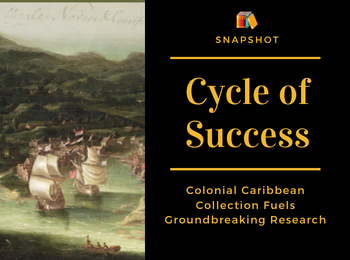
Cycle of Success: Colonial Caribbean Collection Fuels Groundbreaking Research

For historian Brendon G. Floyd, Ph.D., access to Mizzou Libraries’ digital collections has transformed the way he researches the Atlantic world, opening new avenues for scholarship while bringing rare historical records directly to his desktop.

A University of Missouri DPAA Research Partner Fellow affiliated with the History Department and the Kinder Institute on Constitutional Democracy, Floyd studies the United Irishmen who participated in Ireland’s 1798 rebellion and were later imprisoned, forcibly conscripted into the British military, and dispersed throughout the Atlantic world. His work explores the human impact of state power through imprisonment, forced migration, and military service during a period of revolution and empire between 1776 and 1820.

Central to Floyd’s current and future research is the Colonial Caribbean Collection. This digital archive, which provides online access to colonial office files from the United Kingdom National Archives, covers the history of the various territories under British colonial governance from 1624 to 1870.
“My first book follows these Irish prisoners out of Ireland and through spaces of confinement and transit, including internment camps, prison ships, naval vessels, and troop transports,” Floyd said. “My second book picks up where the first ends, following these conscripted rebels into the Caribbean, where many were forced to serve for life in the British Army.”

The Colonial Caribbean Collection has made that work far more accessible.

“Rather than trying to arrange repeated trips to The National Archives in England, I have been able to download thousands of documents and work through them carefully over time,” Floyd said. “That kind of access has changed what is possible for both projects.”

The collection has also led Floyd to new research questions and discoveries. Among them is a project focused on Jean Kina, an enslaved man from Saint-Domingue who served with British forces during the Haitian Revolution, rose to the rank of colonel, and later led a mutiny in Martinique after attempts were made to re-enslave him and others serving under British rule. Floyd has also uncovered materials related to piracy in the Caribbean during the seventeenth and early eighteenth centuries, expanding the scope of his future scholarship.

Beyond supporting research, the collection enhances student learning. Floyd regularly incorporates primary source materials into classroom projects, giving students opportunities to engage directly with historical evidence and develop hands-on research skills.

Floyd credits Mizzou Libraries faculty and staff with making collections more accessible and helping researchers uncover new possibilities. He highlighted his collaboration with Rachel Brekhus on the Haskell Monroe Project, which focused on digitizing and organizing historical materials for research and teaching.
When asked what advice he would offer other researchers, Floyd’s answer was simple: connect with librarians and explore the library’s digital resources.
“Libraries have a deep bench of expertise, and a short conversation with a librarian can lead you to sources, collections, or search strategies you would not have found on your own,” he said.

Floyd also emphasized the often-unseen work performed by library employees.

“Researchers regularly rely on these collections and services without fully acknowledging how much labor goes into acquiring, organizing, digitizing, and maintaining them,” he said. “Much of that work happens quietly, but it makes our research and teaching possible.”

Through resources like the Colonial Caribbean Collection, Mizzou Libraries continues to support innovative scholarship, expand access to unique historical materials, and help researchers and students make discoveries that advance knowledge and learning.


home Gateway Carousel, Resources and Services Take a Study Break with Calming Crafternoons at Ellis Library

Take a Study Break with Calming Crafternoons at Ellis Library

Join us for Calming Crafternoons at Mizzou Libraries! This series of events features easy and creative crafts. Take a break from studying and enjoy some stress relief while crafting.

Find all Mizzou Libraries’ events on Engage – search library.

Fall 2026 Events

Calming Crafternoons: Diamond Painting
Date: 9/17
Location: Ellis Library Main Floor 1:30 – 4:30pm
Description: Get ready to turn your fridge into a sparkling art gallery! Join us for a laid-back Calming Crafternoon for Diamond Painting Fridge Magnets. Whether you’re a seasoned diamond artist or just love shiny things, this event is all about relaxing, chatting, and creating something delightfully tacky—or genuinely chic—for your kitchen. All supplies are included. Everyone is welcome!

Calming Crafternoons: Spooky Crochet Critters
Date: 10/7
Location: Ellis Library Main Floor 1:30 – 4:30pm
Description: Get ready to get your cozy craft on! Whether you’re a complete beginner who has never held a hook or a seasoned yarn enthusiast, come spend a fun, laid-back afternoon bringing a spooky-cute companion to life. You get to pick your path: crochet a giggle-worthy ghost, a friendly little spider, or a plump pumpkin! All supplies are included. Everyone is welcome!

Calming Crafternoon: Tassel & Beaded Garland/Keychain
Date: 11/5
Location: Ellis Library Main Floor 1:30 – 4:30pm
Description: Get ready to string together some serious style! Join us for a fun, fabulous, and totally tactile workshop where we’re turning colorful yarn, wooden beads, and vibrant accents into gorgeous Tassel & Beaded Garland and Beaded Keychains. All supplies are included. Everyone is welcome!

Calming Crafternoons: Gnomes and Pom-Pom Otters
Date: 12/2
Location: Ellis Library Main Floor 1:30 – 4:30pm
Description: Get ready for the ultimate showdown of cozy, whimsical crafting! Whether you’re team mystical garden creature or team fluffy aquatic cutie, this crafternoon is double the fun! Come spend a relaxing session crafting your choice of a bearded Gnome or a fuzzy Pom-Pom Otter (or stay double-focused and make both!). All supplies are included. Everyone is welcome!