home Gateway Carousel, Resources and Services, Support the Libraries Expanding Access to Music Resources at Mizzou Libraries

Expanding Access to Music Resources at Mizzou Libraries

Mizzou is dedicated to preparing students to make meaningful contributions to the world—as performers, composers, teachers and scholars—while expanding the understanding and impact of music through performance, composition and research. Mizzou Libraries plays a vital role in this mission, and thanks to generous donor support, that role continues to grow.

Since joining Mizzou Libraries, Music Librarian Janet Hilts has been focused on strengthening and expanding music collections to better serve the academic community. Recent investments have significantly enhanced access to both digital and print resources that support performance, instruction and research across the School of Music.

One notable addition is IPA Source, a digital tool designed especially for voice performance students. This resource provides International Phonetic Alphabet transcriptions of aria and art song texts, supporting accurate pronunciation and deeper engagement with vocal repertoire.
Another major enhancement is the new subscription to nkoda, a vast digital sheet music library. Through nkoda, students and faculty now have access to high-quality editions and in-copyright works for performance, analysis research and instruction. These materials were previously difficult or impossible to access at this scale.

These digital investments are complemented by substantial growth in physical collections. Between fiscal years 2023 and 2025, the number of music scores and books acquired annually increased by 123 percent. In fiscal year 2025 alone, 302 new music resources were added to the collection. This expansion was made possible in large part by the collaborative efforts of humanities librarians, who worked together to reallocate monograph funds more equitably. As a result, the fund for score and music book purchases increased by 79 percent.

With more music resources comes more behind-the-scenes work. The expertise and dedication of the Acquisitions, Collections and Technical Services team have been essential in ensuring these materials are acquired, processed and made accessible to users. Their efforts help transform donor generosity into tangible impact for students and faculty.

Collaboration between Mizzou Libraries and the School of Music continues to deepen. Currently in development is an ensemble sheet music collection project, along with ongoing efforts to add digital scores of new music by living composers. These initiatives point toward an exciting future of continued growth and innovation.

Your support helps ensure that Mizzou’s musicians have the resources they need to learn, create, and perform—today and for years to come. If you’d like to learn more about creating an endowment to support the Mizzou Libraries contact Matt Gaunt.

home Support the Libraries DMiL Expands: A New Era of Student Innovation at Ellis Library

DMiL Expands: A New Era of Student Innovation at Ellis Library

The Mary Jane and Stephen D. Smith, PhD, DMiL Training Center has been made possible through a generous gift from the Rev. Ann Evans Self. Ann named the space in honor of her parents, who along with her grandparents, James E. and Mary Potter Kunkler, inspired her Mizzou philanthropy. The family’s generosity across three generations has resulted in major gifts supporting MU Libraries, The School of Journalism, The School of Medicine, The College of Engineering and The College of Education & Human Development. Their commitment to Mizzou has also included service on numerous boards and committees and we are truly honored to recognize their love of Mizzou in this important new space in Ellis Library.
The Digital Media and Innovation Lab (DMiL) in Ellis Library continues to grow as a hub for student creativity and exploration, and this year marks an exciting new chapter. Thanks to new equipment provided by Mizzou’s Center for Academic Success & Excellence (CASE) and a generous donor pledge, we’re now positioned to enhance DMil’s resources and expand its vision for the future.

Recently, the DMiL integrated professional-grade audio and video podcast equipment from the CASE Podcast Studio, significantly enhancing its capacity to support student projects. The addition of high-quality microphones, a studio-level soundboard, installed cameras, and a camera-switching console means students now have access to advanced audio and video production for podcasts and interviews. Coupled with a professional rack setup, students now have access to cutting-edge tools alongside staff support and training to use them effectively.

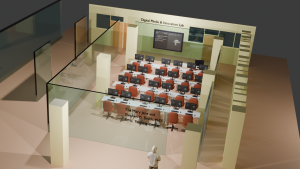
At the same time, the Lab is preparing for a transformational step forward: the creation of a freestanding, glass-enclosed classroom adjacent to the DMiL. This flexible, high-tech learning space will house up to 20 high-performance workstations, giving students the chance to develop skills in video editing, 3D modeling, audio editing, VR/AR design and more. Beyond providing structured workshops and class sessions, the transparent design will invite passersby to see innovation in action.

Together, these developments reflect the DMiL’s mission to provide equitable access to emerging technologies and to prepare students for a digital-first world, job market and self-directed continuing education. With the integration of new production equipment and the forthcoming classroom space supported by donor generosity, Ellis Library is positioning itself as a central destination for digital fluency at Mizzou. The DMiL will also provide support for teaching faculty who develop assignments that give students the opportunity to develop new skills that will benefit their future studies and employment goals. The DMiL isn’t just about giving students tools—it’s about giving them the confidence, skills and opportunities to tell their stories, collaborate and thrive in the evolving media landscape.

rendering of a classroom
Rendering of the DMiL expansion
home Support the Libraries 2025 MU Remembers: Honor with Books

2025 MU Remembers: Honor with Books

This year’s MU Remembers ceremony, commemorating students, faculty and staff who have passed away in the last year, will be held Friday, April 5. A book in remembrance of each honoree will be added to the University of Missouri Libraries’ collection. Commemorative bookplates are placed inside the books, and honorees’ names are placed on the books’ library catalog records.

Honor with Books

The honorees’ names and the books selected in their memory are listed below.

Student
Candyce Richie: Gitlin, M. (2024). The spirit of freedom: Powerful women of the civil rights movement. Rowman & Littlefield.

Faculty and Staff

William D. Allen: Wójcik, D. (2024). Atlas of finance: Mapping the global story of money. Yale University Press.

Wanda Birchler: Taylor, M. (2022). How birds live together: Colonies and communities in the avian world. Princeton University Press.

Sadie Chandler: Burroughs, C. & Gainor, J. E. (Eds.). (2024). The Routledge anthology of women’s theatre theory and dramatic criticism. Routledge.

Joseph Chirillo: Fischer, C. S. (1994). America calling: A social history of the telephone to 1940. University of California Press.

Hope Christofferson: Magaloni, D., Domenici, D., & de Carteret, A. (Eds.). (2024). We live in painting: The nature of color in Mesoamerican art. DelMonico Books.

Jean Day: Tallamy, D. W. (2019). Nature’s best hope: A new approach to conservation that starts in your yard. Timber Press.

Doreen Frappier: Koutsopolous, T. (2024). A new approach to dogs and dog training: Human-canine synergy in theory and practice. Springer.

Jordan Garza: Consalvo, M. (2016). Atari to Zelda: Japan’s videogames in global contexts. MIT Press.

Michael Goldschmidt: Lucas, D. (2021). Ecological buildings: New strategies for sustainable architecture. Braun Publishing.

Sheryl Kilbourn: Sanjek, R. (2024). American popular music and its business in the digital age: 1985-2020. Oxford University Press.

Wang-Sik Kim: Lim, S. (Ed.). (2024). Politics, international relations and diplomacy on the Korean Peninsula. Routledge.

David Kropf II: Kunze, P. (2023). Staging a comeback: Broadway, Hollywood, and the Disney renaissance. Rutgers University Press.

Douglas Lammers: Eberl, J. T. & Decker, K. S. (Eds.). (2022). Star Wars and philosophy strikes back: This is the way. Wiley-Blackwell.

Charles Marra: Pierotti, M., Monreale, A., & De Santis, F. (2024). Artificial intelligence in accounting and auditing: Accessing the corporate implications. Palgrave Macmillan.

Glenda Payne: Symes, M. (2024). Prints and the landscape garden: Image, illusion, illumination. John Hudson Publishing.

Anna Romero: Alonso, P. (2024). Digital satire in Latin America: Online video humor as hybrid alternative media. University of Florida Press.

Matthew Smith: Wilkinson, C. (2024). Treaty justice: The northwest tribes, the Boldt decision, and the recognition of fishing rights. University of Washington Press.

Jim Sowers: Rao, G. H. R., & Das, U. N. (Eds.). (2025). Cardiometabolic diseases: Molecular basis, early detection of risks, and management. Elsevier Academic Press.

Haoyi Wang: Klein, B. (2024). The insect epiphany: How our six-legged allies shape human culture. Timber Press.

Jon White: Marshall, H. W. (2022). Keep it old-time: fiddle music in Missouri from the 1960s folk music revival to the present. University of Missouri Press.

Paul Whittier, Jr.: Cherrington, J. (Ed.). (2024). Mountain biking, culture and society. Routledge.

Andrew Youkilis: Marks, W. J., & Ostrem, J. L. (Eds.). (2022). Deep brain stimulation management (3rd ed.). Cambridge University Press.