At MU Libraries, we’re committed to making access to research more sustainable, affordable and open. And we need your help!
In traditional publishing models, scholars surrender their copyright to commercial publishers in order to disseminate their research findings in scholarly journals. Publishers then sell or rent that same content back to the institution through journal subscriptions—at ever increasing prices. This unsustainable practice costs institutions millions of dollars every year and creates barriers to access for many. Open access publishing encourages scholars to retain their rights and make their work freely available online, increasing the availability and impact of research.
What You Can Do:
Retain Your Rights: No matter where you publish, the single most important thing you can do to make scholarly publishing more sustainable and equitable is Retain Your Rights. It’s your copyright – don’t just sign it away! Contracts are often negotiable. And read those agreements: you may have more rights to share your research than you realize.
Know Your Options: Choose the right venue for your research and know your open access options. If you’re an editor or manuscript reviewer, ask about the journal’s OA options.
Share Your Work: Deposit your research in MOspace, MU’s Digital Institutional Repository. Submitting your work to MOspace is easy. Just log in with your SSO and complete the Creative Commons license.
Predatory publishing doesn’t just take advantage of authors by misrepresenting review, editorial, and fee structures. It also hinders access to the work itself, hurting the overall enterprise of research. The epidemic of predatory journals reached serious enough heights in 2016 that the Federal Trade Commission charged OMICS, one such publisher of hundreds of predatory journals, for its deceptive practices.
“If it sounds too good to be true, it probably is,” says Janice Dysart, Science Librarian and creator of the Where to Publish Your Research guide. “Be wary of these email solicitations from publishers trying to get you to submit articles to their journals.” She recommends using the Think Check Submit checklist to determine whether a publisher is legitimate.
Anyone can fall victim to predatory journal publishers. Jung Ha-Brookshire, Associate Dean for Research and Graduate Studies, College of Human Environmental Sciences, and Associate Professor and Director of Graduate Studies, Textile and Apparel Management, relates her experience after a graduate student recommended a journal a few years ago. She says, “I didn’t think twice about it. We submitted our paper and got accepted without any revisions. Then they were asking us to send money somewhere in Pakistan.” She still didn’t realize what was happening because she hadn’t even heard of “predatory journals.”
That all changed about a year later when she learned of a list of predatory journals from her colleagues. “We found out that our journal was on that list,” she says. They tried to withdraw their work from the publication but couldn’t. Because the journal wasn’t legitimate, the article could only be found via the specific URL and not by searching, so they pulled the publication information from their CVs. Jung says, “We had to take that manuscript as a loss because we couldn’t even take that paper to other publishers since, technically, it is already published.”
After that experience, Jung now checks with her subject librarian, Noël Kopriva, every time she encounters a journal she hasn’t heard of, “no matter how good the website looks.” Jung advises, “Be careful with choosing the right journals. Do not get fooled by address, location, a beautiful website, and a wonderful set of editorial board names. Check with your librarian first when in doubt!”
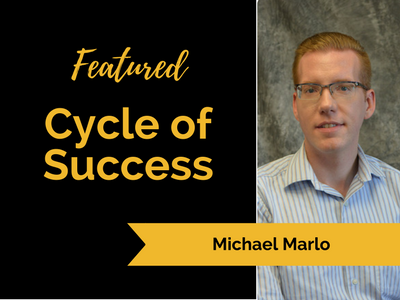
In addition to “producing grammatical descriptions and dictionaries for four varieties of the Luyia language cluster in western Kenya,” Michael Marlo is an Associate Professor of English and Linguistics and a member of the editorial board of the Language Science Press‘s Contemporary African Linguistics series. Language Science Press is an open access publisher of peer-reviewed linguistics books, including textbooks, and neither readers nor authors pay fees under the Knowledge Unlatched model, which instead relies on financial pledges from institutions and libraries to fund open access projects.
Michael’s editorship originally grew out of a desire to find a financially reasonable publishing outlet for the proceedings of the Annual Conference on African Linguistics. When researching potential publishers for book projects related to his National Science Foundation project, Structure and Tone in Luyia, he had also made note of their African Language Grammars and Dictionaries series.
“One of the major obstacles to the development of the field of linguistics is access to research results,” Michael says. For example, access to the digital version of the most prestigious publisher’s grammar series costs $10,000 plus annual fees for updates. A single book costs $200. Despite the prestige, Michael doesn’t intend to pursue publication through a press with such a prohibitive pricing model because that would limit his audience to those few whose libraries can afford access. He says, “While I recognize that there are still problems of access with publications that are primarily available as PDF downloads online, due to the fact that not everyone has internet access, having my work available for anyone to download is a major improvement in access over most other publishing options, which are either too expensive for readers or require a large subvention from the author, or both.”
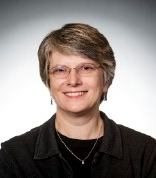
Anne Barker
Last summer, Michael learned that Language Science Press was pursuing the institutional support funding model and asked Anne Barker, his subject librarian, if Mizzou Libraries could contribute. He was “thrilled” to learn that some funds from the National Endowment for the Humanities were able to be put toward the initiative. Michael says, “I believe [this model] has the chance to revolutionize publishing in my field, and possibly by extension many other fields in academia.”
Anne confirms, “Librarians have long been concerned that the commercialization of scholarly communication restricts access for individuals and strains library budgets. Changing the traditional publication funding model to provide for more open access is complex and challenging, but the Knowledge Unlatched model is promising. Mizzou Libraries is glad to be able to join this endeavor.”
Michael encourages students to use MOBIUS and Interlibrary Loan to access books outside of our collection. He also encourages students to find their subject areas in the stacks and look around. “There’s a lot of great stuff in there that you won’t easily find just by searching online databases!”
Cycle of Success is the idea that libraries, faculty, and students are linked; for one to truly succeed, we must all succeed. The path to success is formed by the connections between University of Missouri Libraries and faculty members, between faculty members and students, and between students and the libraries that serve them. More than just success, this is also a connection of mutual respect, support, and commitment to forward-thinking research.
If you would like tosubmityour own success story about how the libraries have helped your research and/or work, please use the Cycle of Success form.
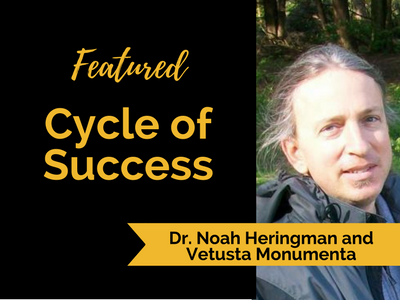
Dr. Noah Heringman, the Catherine Paine Middlebush Professor of English at MU, specializes in the relationship between literature and the history of ideas in the late 18th and 19th centuries. He and his editorial team were recently awarded a three-year National Endowment for the Humanities Scholarly Editions and Translations grant to complete their digital edition of Vestusta Monumenta. Vetusta Monumenta was the first of four major publication series launched by the Society of Antiquaries of London in the eighteenth century. Seven volumes were published between 1718 and 1906.
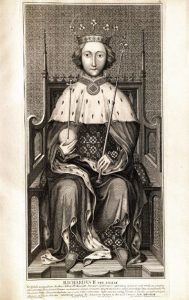
An engraving from”Vetusta Monumenta” of King Richard II in the sanctuary of Westminster Abbey. (Courtesy of University of Missouri-scalar.usc.edu/works/vm/plate-iv-westminster-portrait-of-richard-ii-nh?)
“Kelli Hansen of Special Collections help[ed] us a great deal during the early stages of the process. She gave Amy Jones, [our first research assistant], access to the division’s Indus 9000 book scanner and taught her how to use the software needed for processing the images. After Amy graduated in 2013, two more key players came on board the project: Felicity Dykas, who is now the head of Digital Services in Ellis, and Kristen Schuster, a PhD student in the iSchool (SISLT), who became Amy’s replacement. Felicity and her team took over the scanning project and scanned the remaining five volumes of Vetusta Monumenta at a uniformly high standard of excellence and added them to the University of Missouri Digital Library using the library’s Islandora content management system. In these early years, we got excellent support from other librarians, including Mike Holland (head of the division), Anne Barker, Ann Riley, Ala Barabtarlo, and others.”
The NEH grant is part of a category of funding that supports the “preparation of editions and translations of texts that are valuable to the humanities but are inaccessible or available only in inadequate editions.” This prestigious grant will allow Dr. Heringman, and his co-project director, Dr. Crystal B. Lake of Wright State University, to publish the remaining 144 plates in volumes 1-3, will full commentary by Fall 2020.
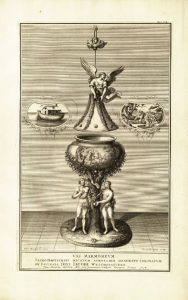
An engraving from “Vetusta Monumenta” of a baptismal font in St. James’s Church, Piccadilly (Courtesy of University of Missouri-scalar.usc.edu/works/vm/plate-iii-marble-baptismal-font-1?)
Vetusta Monumenta provides an intimate record of the kinds of objects collectively judged to be important by a large body of scholars and amateurs over generations. In some cases, these prints are the sole record of those artifacts and monuments, so digital preservation of these prints is vital. A previous digital version exists, but is not open access and does not provide high quality images. Dr. Heringman and his team have made this present edition accessible to all, while also providing scholarly commentary and search tools in order to browse through images.
“With substantial collaboration from the Society of Antiquaries, the Association for Networking Visual Culture at USC, and a growing team of scholarly collaborators, we had published twenty-six plates with commentary, a general introduction, and extensive editorial apparatus by mid-2017, and were able to secure a three-year, 286-thousand dollar Scholarly Editions Grant from the NEH to complete the project.” The project may be viewed at vetustamonumenta.org
Cycle of Success is the idea that libraries, faculty, and students are linked; for one to truly succeed, we must all succeed. The path to success is formed by the connections between University of Missouri Libraries and faculty members, between faculty members and students, and between students and the libraries that serve them. More than just success, this is also a connection of mutual respect, support, and commitment to forward-thinking research.
If you would like tosubmityour own success story about how the libraries have helped your research and/or work, please use the Cycle of Success form.