Written by: Lottie Say
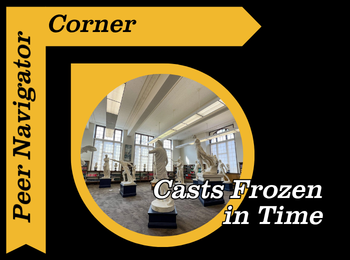
One of my favorite parts of freshman year at Mizzou was exploring Ellis. I recall wandering around The Grand Reading Room and coming across the many statues; I took pictures of them like a tourist. Little did I know these casts held more significance than artistic decor – they are a visible reminder of our university’s long-standing history and commitment to the humanities. These figures are actually precise plaster casts of some of the most famous sculptures in human history. The collection was assembled when 19th and early 20th century students studying ancient Greek and Roman culture in the Midwest were learning about plaster reproductions of famous sculptures. The educator in charge of this awesome, hands-on lesson plan was Professor John Pickard, who was also the first chairman of the Department of Art History and Archeology and creator of the Museum of Art and Archeology in Ellis Library. Pickard was able to travel to Europe in 1895 and 1902 with the mission of bringing the plaster casts home to Missouri. Pickard passed away in 1937, but his legacy lives on through these casts and fellowships named in his honor.
To truly appreciate that legacy, we must look closer at the plaster itself. These casts are some of the few surviving collections of its type – many were destroyed after World War II and modern museums don’t allow castings any longer since the process can damage the original sculpture. Plaster casts are important in preserving fragile or lost sculptures, the original marble statues of the casts were made over 1000 years ago and have suffered decay since then. Mizzou’s plaster versions are able to maintain crisp details of these figures that have since worn away. Some of the detail can be seen through the thin lines while studying the casts closely, these are called “seam lines” from different multi-piece molds used when crafting the sculpture. Upon first look, these pieces seem heavy and stationary, but the cases are actually incredibly fragile! When moved across campus, multiple people wear gloves to avoid oil transfer along with foam padded carts to prevent breakage. Touching a piece of history would surely be a rush, but similar to the average museum, these pieces must stay as a legacy of ancient art which of course means… no touching!
In the spirit of college rivalry, Mizzou has had more casts on display than KU for almost two centuries! These casts connect us to the first students of MU, linking our late night study sessions to theirs. Next time you are enjoying the peace in The Grand Reading Room, wander over to its neighbor and observe the stunning casts in room 202!