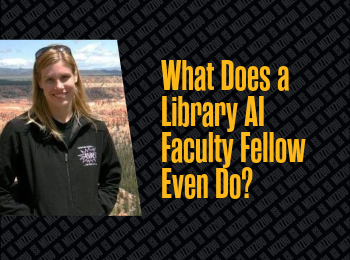
When sharing that I’m the Libraries’ AI Faculty Fellow, the most common response is a polite nod followed by a puzzled, “So, what do you actually do?”
To start, there’s the deep dive into the world of AI. For libraries, this means going beyond ChatGPT, exploring research applications and research-specific AIs. It’s learning how models are trained, wrestling with questions about copyright and privacy, and attending presentations that range from webinars to an AI Summit hosted by the University of Florida. Essentially, it’s being a perpetual student of AI and then trying to translate that knowledge into actionable insights for the campus community.
Collaboration with other Faculty Fellows, committees, working groups and task forces is another big part of the role. As I learn about the variety of projects across campus, for example, the College of Education’s open-access AI instruction cookbook and Physical Therapy’s AI model that simulates patients for students to practice with, I help connect researchers who would benefit from the developing applications and use cases. I’ve participated in the development of department and campus AI policies by leading and consulting during policy workshops, and am involved in testing different GenAI models as part of the Show-Me AI pilot, trying to determine what might be the best applications for Mizzou to invest in and share.
Back in the library world, I chair a team testing research AI tools — like Keenious, Scite and Elicit — that might enhance the discoverability of library resources. But it’s not just about tools – we are getting more questions about AI on chat and through email all the time. I get to tackle the tough questions we receive, relating to AI hallucinations and whether library-subscribed journal articles can legally be used to train large language models for data extraction. With the disclaimer that, of course, I’m not a lawyer and can’t give legal advice, it means staying up to date on court decisions, lawsuits, and emerging legal frameworks (Updated Map of US Copyright Suits v. AI).
Of course, all this learning means nothing if it isn’t shared. In addition to traditional classroom instruction and library workshops, I’ve presented at the Directors of Graduate Studies Summit, as a panelist for a MOBIUS E-Resources webinar on AI, at a campus-wide donor event representing the work MU does with AI, at retreats for updating curriculum, at departmental trainings for graduate students, at the Missouri Library Association Annual Conference and more.
Sharing AI literacy information includes the creation (and continual updating) of our Libraries AI LibGuide, and collaboration with librarians from across the state to build an online AI resource guide. Outreach also includes training the Libraries’ student Peer Navigator team on AI so they can pass that knowledge along to their peers.
It’s been exactly one year since I became the Libraries’ AI Faculty Fellow. While there’s been a lot to learn, somewhere between the webinars, policy discussions and presentations, I get to have great conversations about how libraries can lead — thoughtfully, ethically and creatively — in an AI-driven world.
Kimberly Moeller
Librarian IV, Education & Social Sciences Librarian
University Libraries AI Faculty Fellow