home Gateway Carousel, J. Otto Lottes Health Sciences Library, Resources and Services Royal Society of Chemistry Added to Open Access Publishing Agreements Available to MU Authors

Royal Society of Chemistry Added to Open Access Publishing Agreements Available to MU Authors

Publishing open access is a great way to keep research open and retain your copyright. We do understand that publishing open access comes with a financial commitment that you wouldn’t necessarily have with traditional publishing.

To help offset costs, Mizzou Libraries has agreements with several publishers to offer discounts and author processing charge support for the following journals.

Want to lean more? Talk with your Subject Specialist about open access in your area.

NEW AGREEMENT: Royal Society of Chemistry (RSC)
The MU Libraries now has a Read & Publish agreement with the Royal Society of Chemistry, starting in 2024 and continuing through 2025. All charges for publishing in Hybrid, Gold and RSC Advances journals are covered for MU corresponding authors. Articles published open access in RSC journals are downloaded more often, which helps raise the visibility of your work Here is a complete RSC Journal list. Find out more.

American Chemical Society (ACS) Journals
The American Chemical Society offers a discounted open access fee to MU affiliates since MU is a Subscribing Institution. Members of ACS receive an additional discount. ACS Open Access Fee Chart

Astronomy & Astrophysics: A European Journal
Starting in 2022,  the EDP Sciences journal Astronomy & Astrophysics will be published under the Subscribe to Open (S20) model.  MU affiliated corresponding authors can publish their articles Open Access without paying APC’s (article processing charges) as long as the University of Missouri Libraries continue to subscribe to this title.

BMJ Case Reports
The Health Sciences Library subscription to BMJ Case Reports includes a waiver of the individual membership fee of £273 normally required to publish cases. Submission instructions.

Cambridge University Press Journals
MU Libraries has entered into a transformational “Read and Publish” agreement with Cambridge University Press. This agreement greatly expands electronic access to Cambridge University Press journals and provides 10 APC waivers for MU corresponding authors to publish their work OA.

Because of the limited number of waivers available with this agreement, MU Libraries has decided to support authors on a first come, first served basis. If there are remaining waivers at the end of the year, MU Libraries can retroactively make other articles OA with the approval of the author. Read more about the agreement and see a list of eligible journals

Company of Biologists
From 2023 through 2025 MU is participating in the Company of Biologist’s Read & Publish Open Access Initiative. MU authors can publish OA at no charge. Some of the journals Company of Biologists publishes include Development, Journal of Cell Science, and Journal of Experimental Biology.

Electrochemical Society (ECS) Journals
MU is a subscriber to ECS Plus, an agreement that allows MU faculty to publish their articles in Electrochemical Society (ECS) journals (Journal of the Electrochemical Society and ECS Journal of Solid State Science and Technology) as Open Access with no charge to the author. There are no limits on the number of papers that can be published in any given subscription year. Find out more.

Journal of Agriculture, Food Systems, and Community Development
The University of Missouri has joined the shareholder consortium of the Journal of Agriculture, Food Systems, and Community Development. This open-access journal features interdisciplinary academic research and practice articles on all things food systems. The shareholder membership, good through April 2024, covers the University of Missouri-Columbia, including MU Extension. This membership waives the typical Article Processing Charge for publishing in this journal.

Proceedings of the National Academies of Science of the United States of America (PNAS)
MU researchers publishing articles in Proceedings of the National Academy of Sciences (PNAS) receive a discounted open access fee of $2,000, compared to the regular fee of $2,500, to make their papers immediately free online. Find out more.

home Gateway Carousel, Resources and Services Celebrate Open Access Week With Mizzou Libraries

Celebrate Open Access Week With Mizzou Libraries

Open Access Week is a global event that invites us all to take action and reflect on how we share knowledge. It’s about empowering communities to have a say in how research and information are created, accessed, and used.

Open Access means free, immediate, online access to scholarly research—and the ability to use and build on that work without barriers. This openness has the potential to transform how we conduct research, teach, and innovate, impacting everything from medicine and science to industry and society as a whole.

Take some time this week to learn more about Open Access and consider: Who owns your knowledge?

home Cycle of Success, Gateway Carousel Welcome to Dylan Martin

Welcome to Dylan Martin

The Mizzou Libraries are pleased to welcome Dylan Martin as research and instruction librarian, supporting social sciences and cultural studies departments, and chairing the library’s copyright team. A passion for public service and education drives his commitment to libraries.

He began his library career as an intern at Ellis Library after earning a B.A. in English literature from Mizzou. He later completed his MLIS at the School of Information Science and Learning Technologies. He held a reference assistantship during graduate studies and completed internships focused on archives and community history.

Martin previously served as institutional repository librarian at Lincoln University of Missouri, where he supported STEM departments and led technology and media initiatives. From 2021 to 2025, he worked at Columbia’s community radio station KOPN 89.5FM, managing operations, leading a major relocation project, and eventually serving as general manager.

Now back at Mizzou Libraries, Martin brings a diverse background in librarianship, media, and community engagement. His research interests include copyright, intellectual freedom, and community history archives.

Outside of work, Martin enjoys kayaking, mountain biking, exploring new cuisines, and amateur radio (Technician Class – KE0YNK). He also enjoys tinkering with musical instruments, electronics, and mechanical devices.

home Cycle of Success, Gateway Carousel Cycle of Success: Resource Sharing Team Navigates International Law to Support Faculty Research

Cycle of Success: Resource Sharing Team Navigates International Law to Support Faculty Research

When a faculty member requested a rare academic title available only in a few libraries in Germany, the Mizzou Libraries’ Resource Sharing team sprang into action. The title was not held by any U.S. libraries, and only two German institutions participating in OCLC’s International Interlibrary Loan (ILL) service had it in their collections. Ordinarily, these libraries reliably fulfill our requests. But this time, both declined. The reason? A surprising consequence of international trade policy.

Ivy Hui, a senior library specialist in Access Services, stated, “We were informed that beginning on August 22 of this year, the Deutsche Post/DHL will not ship packages to the US due to new rules in place between the US and the EU where packages of under $800 in value are no longer exempt from duty.”

Despite the setback, the Resource Sharing team didn’t give up. They worked closely with the faculty member to identify the most critical sections of the book. With the help of the German libraries, they obtained the table of contents and secured scans of two key chapters. These were delivered to the faculty member using a different software platform, in full compliance with German copyright law.

This story is a powerful reminder of the value of the Resource Sharing/Interlibrary Loan (ILL) service. Even when traditional borrowing isn’t possible, our team finds creative solutions to connect researchers with the materials they need.

home Gateway Carousel, Support the Libraries DMiL Expands: A New Era of Student Innovation at Ellis Library

DMiL Expands: A New Era of Student Innovation at Ellis Library

The Mary Jane and Stephen D. Smith, PhD, DMiL Training Center has been made possible through a generous gift from the Rev. Ann Evans Self. Ann named the space in honor of her parents, who along with her grandparents, James E. and Mary Potter Kunkler, inspired her Mizzou philanthropy. The family’s generosity across three generations has resulted in major gifts supporting MU Libraries, The School of Journalism, The School of Medicine, The College of Engineering and The College of Education & Human Development. Their commitment to Mizzou has also included service on numerous boards and committees and we are truly honored to recognize their love of Mizzou in this important new space in Ellis Library.
The Digital Media and Innovation Lab (DMiL) in Ellis Library continues to grow as a hub for student creativity and exploration, and this year marks an exciting new chapter. Thanks to new equipment provided by Mizzou’s Center for Academic Success & Excellence (CASE) and a generous donor pledge, we’re now positioned to enhance DMil’s resources and expand its vision for the future.

Recently, the DMiL integrated professional-grade audio and video podcast equipment from the CASE Podcast Studio, significantly enhancing its capacity to support student projects. The addition of high-quality microphones, a studio-level soundboard, installed cameras, and a camera-switching console means students now have access to advanced audio and video production for podcasts and interviews. Coupled with a professional rack setup, students now have access to cutting-edge tools alongside staff support and training to use them effectively.

At the same time, the Lab is preparing for a transformational step forward: the creation of a freestanding, glass-enclosed classroom adjacent to the DMiL. This flexible, high-tech learning space will house up to 20 high-performance workstations, giving students the chance to develop skills in video editing, 3D modeling, audio editing, VR/AR design and more. Beyond providing structured workshops and class sessions, the transparent design will invite passersby to see innovation in action.

Together, these developments reflect the DMiL’s mission to provide equitable access to emerging technologies and to prepare students for a digital-first world, job market and self-directed continuing education. With the integration of new production equipment and the forthcoming classroom space supported by donor generosity, Ellis Library is positioning itself as a central destination for digital fluency at Mizzou. The DMiL will also provide support for teaching faculty who develop assignments that give students the opportunity to develop new skills that will benefit their future studies and employment goals. The DMiL isn’t just about giving students tools—it’s about giving them the confidence, skills and opportunities to tell their stories, collaborate and thrive in the evolving media landscape.

rendering of a classroom
Rendering of the DMiL expansion
home Events and Exhibits, Gateway Carousel Dine & Draft: Write with Support (and Sandwiches!)

Dine & Draft: Write with Support (and Sandwiches!)

Got an English 1000 paper to tackle? Join us for the very first Dine & Draft on Wednesday, October 22, from 4–8 p.m. in Ellis Library rooms 115 and 114a. This event is designed just for English 1000 students who want to make real progress on their draft while having support (and food) nearby.

Here’s how it works: bring your draft-in-progress, even just your notes and outline, and settle in for a productive writing session. Writing Center tutors and research librarians will be available throughout the evening to answer your questions, give feedback, and help you move forward with confidence. Whether you’re brainstorming, structuring your essay, integrating sources, or polishing your citations, you’ll have experts right at your side.

And because writing is always easier when you’re not running on empty, we’ll have sandwiches for the first students who arrive, along with a relaxed, focused environment to keep you fueled. Think of it as a study session meets writing workshop, with a little extra motivation to get that draft done. Don’t miss this chance to knock out your English 1000 paper with expert help for when you get stuck!

home Ellis Library, Gateway Carousel, Resources and Services Peer Navigator Corner: Ellis Library – An Architectural Perspective

Peer Navigator Corner: Ellis Library – An Architectural Perspective

Written by: Ahmad Bahir Sherzad

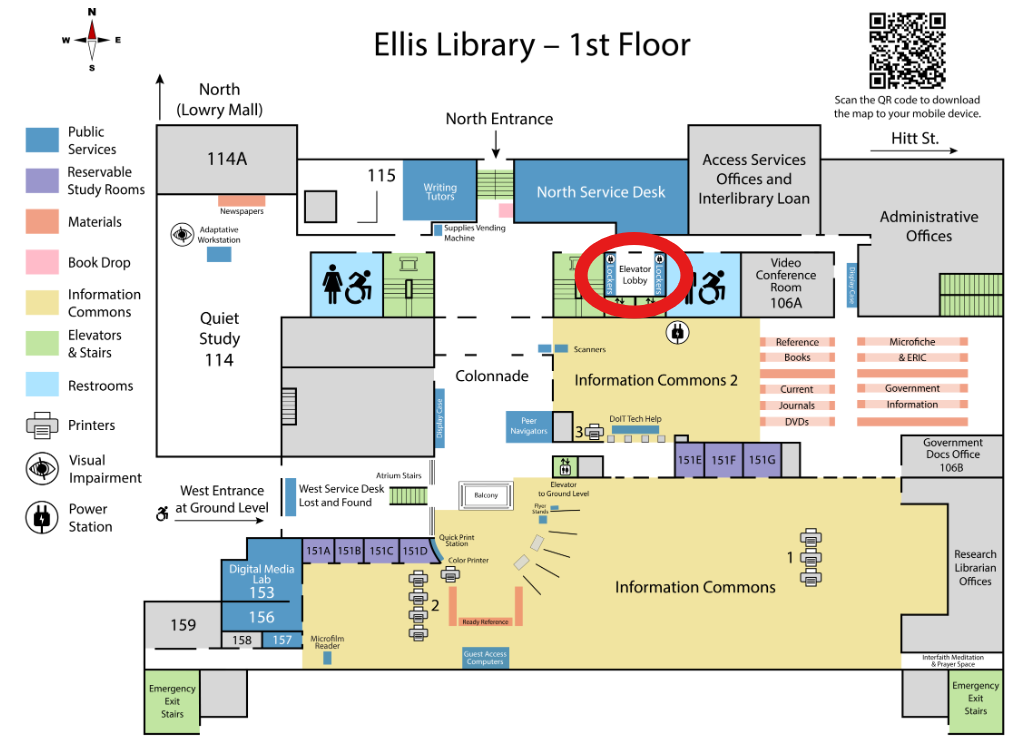
As an architecture student learning about the importance of how principles of architecture affect people’s mood in a space, I wanted to touch on it as a new peer navigator who has walked Ellis Library more times than I can count. In understanding architectural principles and elements, we can have a better understanding of the purpose of different sections of Ellis Library before visiting. In this post, I’ll share a closer look at two of Ellis Library’s most popular study spots – the ground-floor atrium study space and the General Reading Room (201) on the second floor – and how their unique architecture might shape your study experience.

The ground-floor study area near the atrium stairs was added after the original 1915 construction and is now open 24/5. The space consists of a coffee shop-style seating around a small student-run cafe under a structure of stairs that lead to the first floor. When it comes to stratification by the architects of Ellis, the floor consists of many different styled seating options on simple marbled square tiling. It is also crowded with various maps and pieces for spectator viewing on display in booths built into the wall. The head of the space features low-hanging lights and a variety of ceiling heights. Near the doors, the ceilings are raised all the way until the top of the first floor, while under the stairs, of course, they are much lower. The atrium goes from a naturally lit entrance to a cozy, somber, and dark area under the stairs and around the small cafe. All these characteristics create a sense of movement, productivity, and openness to the space.

Diving into the movement, transition, hierarchy, and heart of the ground-floor study space, one can see there is a heavy amount of transitional energy. The main entry is from two sets of large glass doors that lead from the Speakers Circle into Ellis Library. Almost mall-like, the doors are purposely designed to coordinate safety and transition of a vast number of students exiting and entering the library, with one being designated exclusively as an entrance and the other as an exit. Most people enter from glass doors near a large information desk facing into the space all the way towards the back of the study area, where the cafe can be found tucked into the corner. Movement is random in the cafe area, but follows a strict order closer to the desk and openings. The hierarchy of the space is mostly overpowered by the large stairs that lead to the second floor and encompass most of the body of the space. The small coffee tables and booths are given secondary focus, while two large bar-style tables serve as the primary focus when it comes to seating. The space is hectic and loud compared to every other space in Ellis; at no time will you ever hear a pen drop. The cafe in the corner does not pull much of the attention of the space, but rather the heart of the space is the wood and glass-adorned stairs that can be seen from every angle of the atrium. The height of the ceilings upon entrance and the vastness of the stars instantly draw students’ attention and guide them through the space.

The Main Reading Room, originally called the General Reading Room, in Ellis Library at Mizzou was created in 1915 when the library was constructed. The Main Reading Room of Ellis Library is a massive, long, rectangular space defined by two parallel walls. It is organized around a central axis split long ways down the rectangle with rows of brown library tables perpendicular to the walls. When it comes to the stratification of the long linear space, the floor of the Main Reading Room has brown rectangular tables in four long columns filling the vast space, and is surrounded by book-lined walls. The table and chairs are worn by university students over time. As for the body of the room, tall arched windows on the north wall fill the space with natural light, and subtle brown metal molding disguised as wood and white paint cover the vast size of the walls. This stratum creates a feeling of awe and openness in the space. The head of the Main Reading Room features a large, curved ceiling with raised wave motifs and hanging rectangular lights. The curved ceiling immediately creates a sense of awe in any user and adds vastly to the space, honoring its name as the “main” reading room of Ellis Library. The raised ceiling creates a sense of contrast to other spaces in the library. All these create a sense of order, calm, and academic focus.

When it comes to the qualitative aspect of the Grand Reading Room in Ellis Library, the natural light from multiple vast arched windows creates both mood and visibility for students in the space. They allow warm natural light to fill every part of the room, creating a sense of awe and beauty. The light white walls and wood details suggest tradition and purpose. It is a semi-enclosed space within the larger library structure, with three entrances that bring you into a space that is eerily silent compared to the rest of the library, which is quite ironic. The main focus is on the grand windows on one side that define the spatial “heart” of the space. In terms of movement, transition, hierarchy, and heart of the Main Reading Room, the main entry is from the south side between two white columns with a capital on top of both. There is minimal movement in the space due to the silent atmosphere in the room. The movement, or so-called transition, follows the axis, down rows of tables, looking for open seats. The movement at times is also random and hectic across different axes as people look for spaces to inhabit and study, not too close to anyone else. When it comes to the hierarchy of the reading room, the large study tables are the primary focus, and a couple of lounge chairs at the west end are secondary. The heart of the room and even Ellis Library itself are the large windows that draw the eye instantly, define the user’s mood, and set the tone.

Whether you are looking for a more traditional and silent study area or an energizing space, Ellis Library offers both in its intentional designs. To learn more about the history and architecture of Ellis Library, I would highly encourage you to visit the following website, full of archives of Ellis construction photos and of many other study spaces on campus.

https://muarchives.missouri.edu/historic/buildings/ellis/

Research Smarter With Lean Library

Access Mizzou Libraries—Anywhere, Anytime.
Lean Library is a free browser extension available to all current Mizzou students, faculty, and staff. Whether starting your research on Google Scholar, a publisher’s site, or anywhere else online, Lean Library helps you seamlessly connect to library resources—even when you’re off campus or not on Tiger WiFi.
Here’s how it works:

  • Automatically checks if Mizzou Libraries has access to the article or book you’re viewing.
  • Provides direct links to full-text content when available.
  • Prompts you to log in using MU’s Single Sign-On (SSO)—just like email or Canvas.


Need something we don’t have?

Lean Library makes it easy to request articles and books through our Interlibrary Loan (ILL) service—at no cost to you.

Getting started is easy:
Download the Lean Library extension, select the University of Missouri, Columbia, and start accessing library content wherever your research takes you.

For more information, visit our Lean Library guide.

home Gateway Carousel, Resources and Services Digital Media and Innovation Lab in Ellis Library

Digital Media and Innovation Lab in Ellis Library

The Digital Media and Innovation Lab (DMiL) in Ellis Library provides innovative technology and resources for your creative projects.  The DMiL has an Audio Recording Booth, Digital Art Tools, and 3D Scanners in Room 156; interview recording room in Room 157, and a film studio in Room 3E21.

The DMiL is complemented by the Information Commons computers and equipment checkout at the checkout & information desk.  The DMiL is available to students for class or personal projects.

You can make a reservation and check-in or stop by for a consultation in Room 153.

Monday: 11:00am – 8:00pm
Tuesday – Thursday: 10:00am – 8:00pm
Friday: 10:00am – 3:00pm
Saturday & Sunday: Closed

Questions & Consultation email: ellisdml@missouri.edu

home Gateway Carousel, Workshops Research Ready in 15 Minutes

Research Ready in 15 Minutes

This October, the Mizzou Libraries will host Research Ready in 15 Minutes, a two-week series of 15-minute virtual workshops designed to introduce students, faculty, and staff to essential library databases.

Running from October 6 – 17, each session will feature:

  1. A brief overview of a key research database
  2. A live demonstration of search, access, and save features
  3. A highlight of a unique tool or function

The goal of this series is to provide accessible, low-pressure learning opportunities for busy users who need a quick refresher (or an introduction) to resources that support their research and coursework. All sessions will be recorded and posted to our workshops recording page for on-demand viewing.

Find more information and our toolkit on the Research Ready Guide! We encourage you to share the PDF flyer and digital signage with anyone who may be interested or benefit from the series!

We hope to see you at one of the sessions!