Written by: Bri Dunham
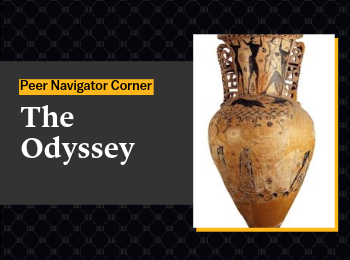
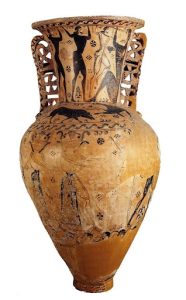
With Christopher Nolan’s The Odyssey recently in theaters, a lot of people have expressed increased interest in the stories told throughout the film. Nolan does an incredible job at illustrating the story of Odyssesus and leaves you wanting more. The Odyssey is often attributed to Homer, an ancient Greek poet, and is thought to have been written down in the 8th century BC. The language used throughout is obviously very different from today’s, however there are many translated versions at Ellis Library available for check out, as well as more of Homer’s other works. Before Homer wrote the epic poem we know today, Odysseus and his journey were actually an oral tale told as early as 12th century BCE and depicted on ancient art across Greece. Most of the artistic interpretations of The Odyssey appeared on everyday objects, especially vases. One of the earliest depictions of The Odyssey is on the Eleusis Neck Amphora, created around 650 BCE, which shows Odysseus and his soldiers blinding the Cyclops Polyphemus.
During my first semester at Mizzou, I signed up for a class called The Ancient Greeks thinking I would learn all about Greek mythology and the different stories of the gods/goddesses. While I did learn about those stories, I also learned about what ancient Greece was truly like and where many of these stories originated from. While most of Nolan’s film follows the events of Homer’s poem, there are a number of other influences as well. For example, the story of Agamemnon’s murder comes from Aeschylus’ tragedy, The Oresteia. Other Greek myths, such as the stories of Ajax and Prometheus, originated from Athenian tragedies or plays. Ellis Library has The Oresteia –and other Greek plays in general– available for check out.
Looking more into current works, a lot of recent mainstream books were also inspired by these Greek myths. Obviously, Percy Jackson is a big one and deals with the Greek gods and myths directly throughout the books. However, less known is that The Hunger Games was inspired by the tale of

Theseus and the Minotaur. The story follows tributes who are sent to be fed to the Minotaur and the hero Theseus, who volunteers to be one of these tributes, ends up killing the Minotaur. You can see the similarities, but there are many other popular books that you probably didn’t know were inspired by Greek myths.
Ancient Greece and Greek mythology has a lot to unpack and learn about. There is a wide selection to choose from here at Ellis, where you can learn more about whatever peaks your interest in Greek mythology. Whether that be The Odyssey as a graphic novel, learning about art inspired by the oral tradition long before it was written down, or a translation of Homer’s poem, the Libraries have you covered. Beyond The Odyssey, check out the East stacks on the 4th floor for ancient plays or Homeric hymns and find your next Greek story!