Thesis Project - Rocheport MRF
Title
Thesis Project - Rocheport MRF
Creator
Moore, Lance
Abstract
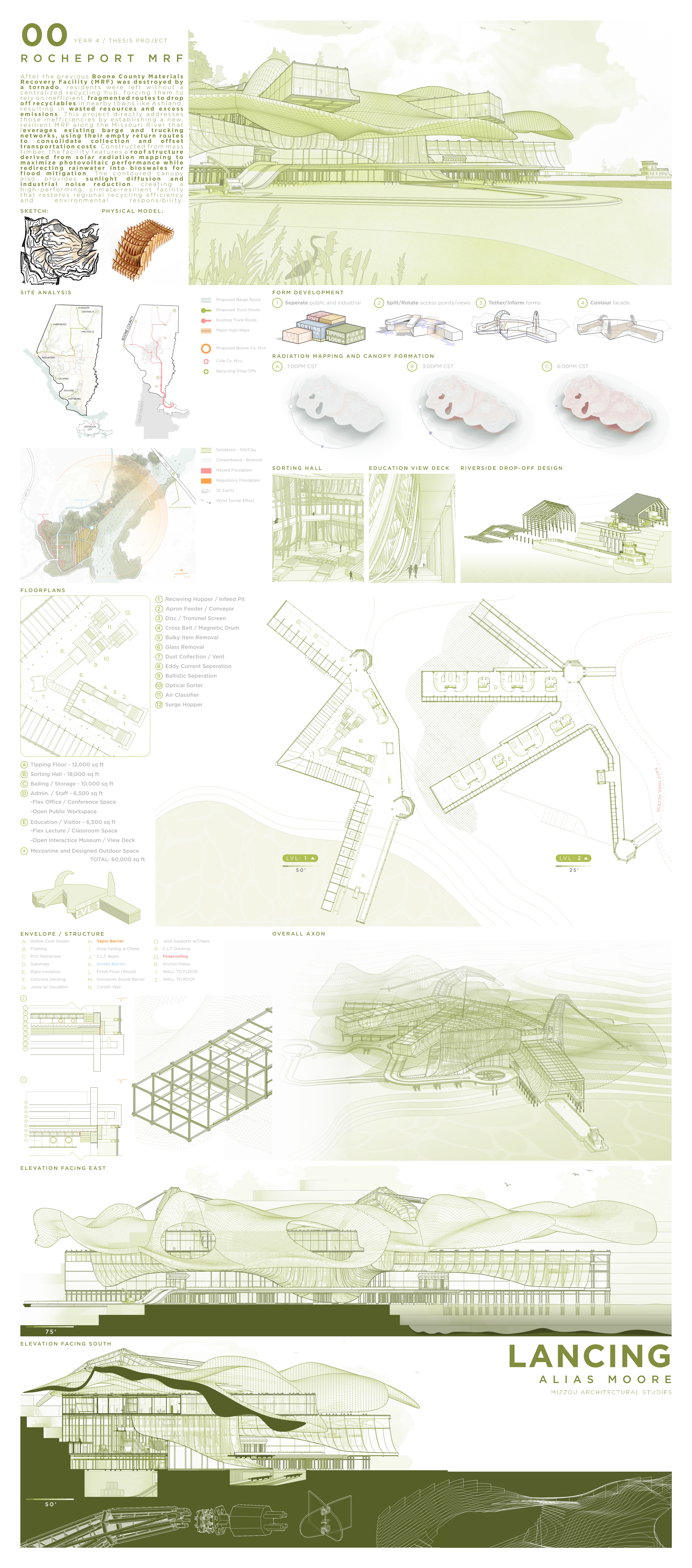
After the Boone County Materials Recovery Facility was destroyed by a tornado, residents were left without a centralized recycling system. Recycling shifted to fragmented drop-off routes in nearby towns such as Ashland, increasing transportation distance, energy use, and emissions. This project responds to that breakdown by proposing a new, resilient Materials Recovery Facility along the Missouri River that restores regional recycling capacity through architectural and infrastructural intervention.
The site is located at a bend in the river where barges naturally slow and idle, adjacent to Interstate 70. This positioning allows the facility to leverage existing transportation networks by redirecting recyclables onto empty return barges and underutilized freight trucks. By using infrastructure that already exists, the project reduces inefficiencies while reframing architecture as an active participant in material flow and environmental accountability.
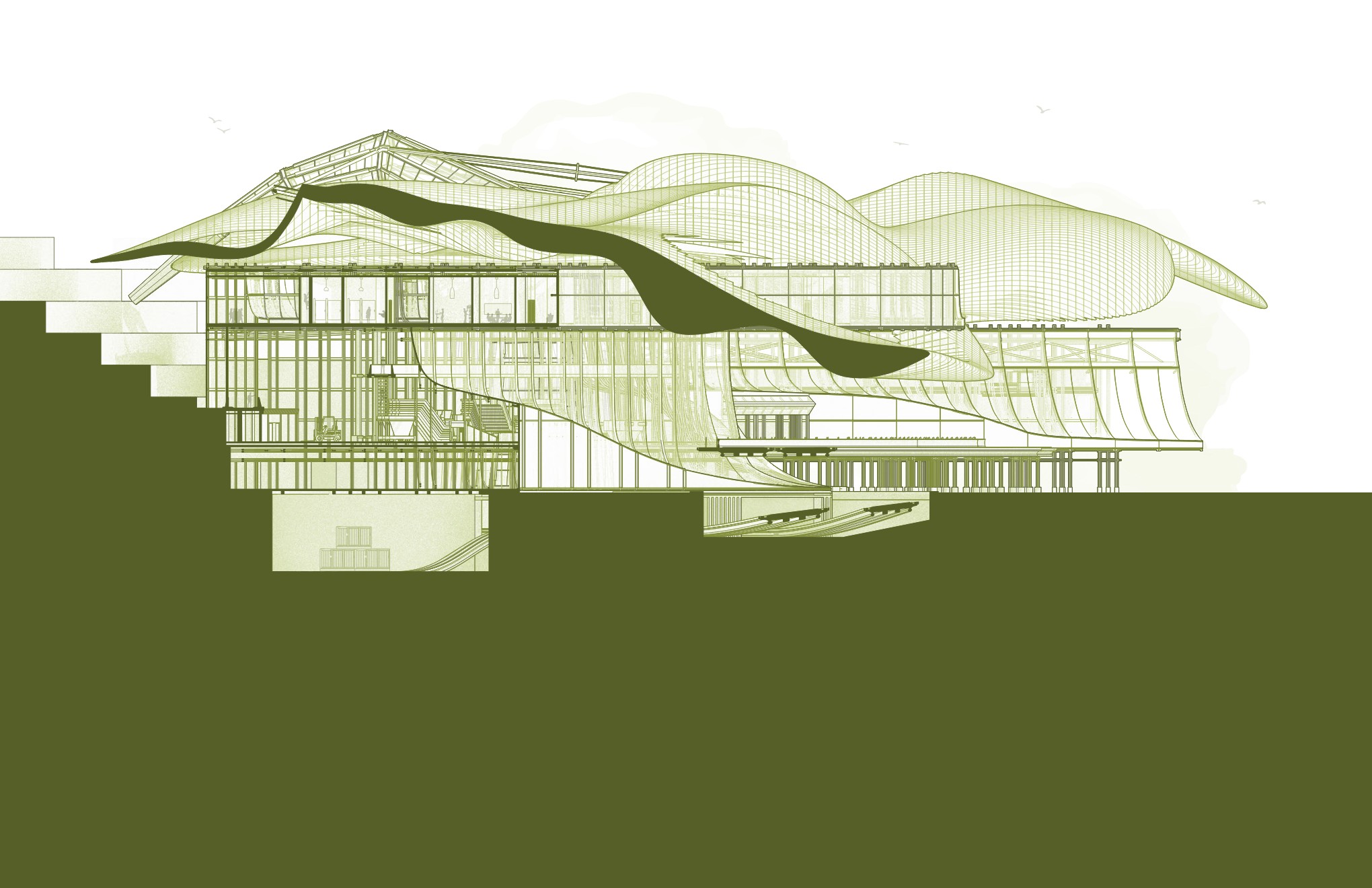
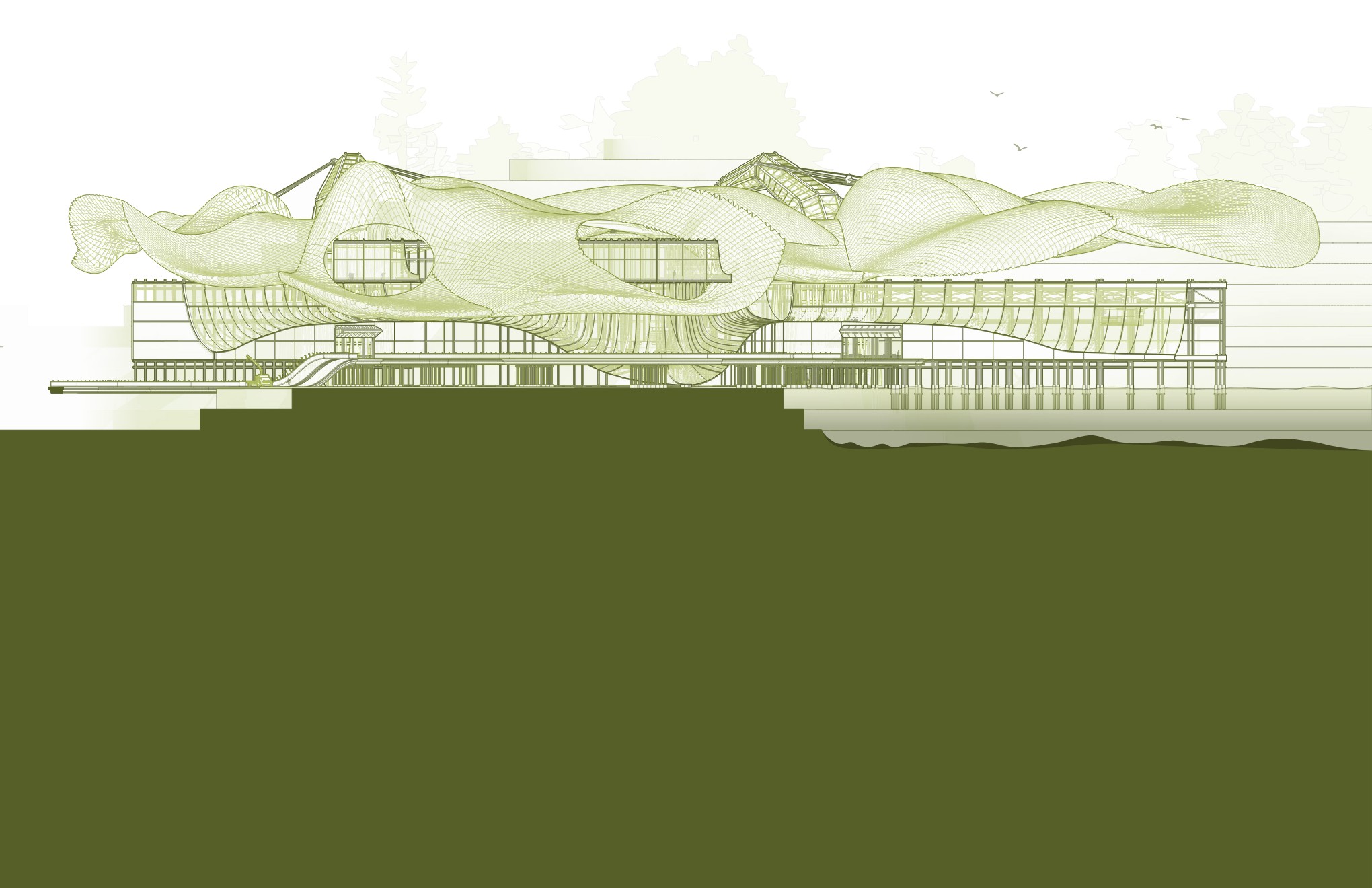
The facility is constructed from mass timber to reduce embodied carbon and allow for prefabrication and efficient transport. The building is elevated to address floodplain conditions, with structural cores anchored into exposed bedrock to provide long-term stability. These strategies respond directly to the site’s environmental constraints while prioritizing durability and adaptability.
A contoured roof canopy is shaped through solar radiation mapping to maximize photovoltaic performance. Its form also diffuses daylight across the sorting floor, reduces industrial noise, and directs rainwater into bioswales for erosion control and flood mitigation. An elevated public path allows visitors to observe the recycling process, making material systems visible and accessible.
Together, these design decisions position infrastructure as both functional and civic, demonstrating how architecture can support environmental responsibility while engaging the public.
The site is located at a bend in the river where barges naturally slow and idle, adjacent to Interstate 70. This positioning allows the facility to leverage existing transportation networks by redirecting recyclables onto empty return barges and underutilized freight trucks. By using infrastructure that already exists, the project reduces inefficiencies while reframing architecture as an active participant in material flow and environmental accountability.
The facility is constructed from mass timber to reduce embodied carbon and allow for prefabrication and efficient transport. The building is elevated to address floodplain conditions, with structural cores anchored into exposed bedrock to provide long-term stability. These strategies respond directly to the site’s environmental constraints while prioritizing durability and adaptability.
A contoured roof canopy is shaped through solar radiation mapping to maximize photovoltaic performance. Its form also diffuses daylight across the sorting floor, reduces industrial noise, and directs rainwater into bioswales for erosion control and flood mitigation. An elevated public path allows visitors to observe the recycling process, making material systems visible and accessible.
Together, these design decisions position infrastructure as both functional and civic, demonstrating how architecture can support environmental responsibility while engaging the public.
Date
2026
Citation
Moore, Lance, “Thesis Project - Rocheport MRF,” MU Libraries Digital Exhibits and Online Forums, accessed October 20, 2026, https://library.missouri.edu/exhibits/items/show/301.